All posts by Grétar Þór Eyþórsson

Amalgamation Reforms in Iceland: How strategies have shaped conflicts and outcomes

Introduction

Municipal amalgamation reforms tend to meet resistance and opposition from the municipalities involved. Such territorial reforms can lead to great changes for the municipalities, as well as their inhabitants, since some may have had their jurisdictional boundaries for a long time. Therefore, it is no wonder that conflicts can occur in connection with such reforms (Baldersheim & Rose, 2010). Such shuffling involving not merely municipal boundaries, but also the political landscape, the structure of municipal administration and service delivery, can lead to comprehensive changes for everyone involved. The Norwegian political scientists Baldersheim and Rose (2010) argue that whether such or suggested changes will lead to conflicts can depend on the strategies used during implementation. They also connect this with the institutional context – national and local – and presented an analytical framework in which institutional context determines both the choice of reform strategy and the pattern of conflicts arising from the reform. All this then determines the outcome. Steiner et al. (2016) examined patterns of conflict related to territorial reforms in European countries using this framework. They based their investigation on surveys among experts in 11 European countries. Their main findings were that top-down initiatives and comprehensive reforms were more likely to trigger conflicts and resistance, while more incremental and bottom-up-oriented approaches would probably engender less struggle and defiance, if any.

In this article, I take a closer look at Iceland, one of the eleven countries from the Steiner (et al. 2016) study, and use Baldersheim and Rose’s (2010) framework to analyze two cases of municipal structure reforms. Specifically, the Icelandic national authorities have twice tried to implement a comprehensive territorial reform at the local level. This has been done by setting up referendums in majority of the municipalities, first in 1993 and later in 2005. Neither of these reforms (or reform attempts) ended up being successful. To better explain what brought about these outcomes I address the following research questions:

  1. What reform strategies were used in the municipal structural reforms in Iceland 1993 and 2005? Were there any conflicts connected to them and if so, what kind of conflicts?
  2. Which were the outcomes of these reforms and can they be seen as consequences of the strategies that were used and the conflicts that came up?

Data and method

The empirical data used is partly from the authors doctoral thesis (1998), where the politics of territorial reforms in Iceland were studied. That data relates to the 1993 referendum on municipal amalgamations in 185 municipalities, its prelude and aftermath. The empirical data used to analyze the reform ending in a referendum in 2005 is mostly from data collection conducted later, but not as thoroughly reported.[1]

In the case of the 1993 reform two kinds of data were used in the analysis. Firstly, the data on voters is from the referendums conducted in November 1993 where the results (yes-votes) in every single municipality were analyzed by the municipality´s population size. Secondly, the data on the local leaders’ through an analysis of their responses to a questionnaire sent out in early 1994. Their attitudes and values were compared on an index that was constructed – an index based on 23 questions about municipal mergers that were sent to the Icelandic municipal leaders.[2]

In the case of the referendums in 2005, population size data and results from the referendums are used. No data on local leaders from that case exists.


1.     Amalgamation strategies, conflicts and outcomes

Baldersheim and Rose argue that whether changes initiated by territorial reforms will lead to any conflicts may largely depend on the strategies used in the implementation process. They present an analytical framework where institutional context determines both the choice of reform strategy and the pattern of conflicts given rise to (Baldersheim & Rose, 2010). Here we focus on strategies, conflicts, and outcomes.

1.1.       Strategies

Baldersheim and Rose define the concept “strategy” as follows: “Strategies are, for our purposes, the procedures of decision-making adopted by policymakers in order to accommodate interests and stakeholders affected by policy initiatives” (Baldersheim & Rose, 2010, p. 12).  They name one of these “The Jacobin strategy”. It has roots in rational objectives or the rational scientific administrative ideal. This is when a reform is set up, planned, and implemented by the national authorities and is comprehensive – a reform that sweeps across the whole country with all the units in the whole system included – “the entire local government structure in the country is analyzed at one point in time,” as worded by Steiner et al. (2016, p. 27). Decisions are made by national-level decision-makers and imposed on local governments. The decisions are, for the most part, forced upon the municipalities. This we can call a comprehensive reform, and the strategy is top-down-oriented, apparently of a strict, forceful, and authoritarian character, but this is not the case in all European countries. Here we should bear in mind that member states of the Council of Europe must respect the charter on local self-government as a rule[3], which means that the member states must allow a certain degree of local participation in the amalgamation processes. This limits the top-down orientation of the strategies that are possible to use (Baldersheim & Rose, 2010). In Norway for example, the local authorities could choose with which other municipalities they amalgamated. In the 1962 amalgamation reform in Sweden (Kommunblocks­reformen) the setup was voluntary in the beginning but due to opposition from smaller municipalities, the process was delayed and finally imposed by means of legislation in 1968 forcing the municipalities to amalgamate in 1971 and 1974 (Strömberg & Westerståhl, 1984).

Things were even more top-down and enforced in the great amalgamation reform in Denmark in 2007. In the beginning, the Danish municipalities could choose merger partners, but the final decision was forced upon them if no such partner could be identified (Baldersheim & Rose, 2010; Baldersheim & Rose, 2016; Steiner et al., 2016; Blom-Hansen et al., 2016; Broekema et al., 2016). Similar methods were applied during the great amalgamation process in Greece. Additionally, in both Denmark and Greece, the Jacobin strategy was partly diluted when the capital regions were excluded from the amalgamation reforms, so the reforms were not fully comprehensive.

Another strategy defined by Baldersheim and Rose is “The Girondin strategy”. Here, initiatives on boundary changes come from local authorities and even national authorities and are accepted by national governments. This is through a “stepwise bottom-up approach with much room for bargaining between national and local elites” (Baldersheim and Rose 2010, p. 13). Steiner (et al.) describe a bottom-up amalgamation strategy as reforms, usually voluntary, where the municipality and its citizens decide on their own whether they want to merge with other municipalities (Steiner et al., 2016, p. 26). Here we see the reverse of the Jacobin strategy; the initiative comes from below, and the reform applies only to parts of the state. This Girondin strategy is characterized by bottom-up initiatives and an incremental approach. (see also Kaiser, 2014; Kaiser, 2015).

1.2.       Conflicts

Attempts to change a country’s territorial division in municipalities are generally bound to meet opposition and conflict. Multiple interests are at stake: local identity, political careers, jobs, and various contracts. All these will be lost as municipalities cease to exist as units, and there will be less need for identity, careers and jobs etc. (Baldersheim & Rose, 2010). At the same time, local identity in a small context can be lost when the territory is no longer independent (Eythórsson & Jóhannesson, 2002). At the same time, central government interests can lie in the need for more competence and enthusiasm at the local level, so that policy at the national level can be better implemented (Baldersheim & Rose, 2016). What kinds of conflicts can arise from this?

Baldersheim and Rose identify two main types of conflict: left vs. right and centre vs. periphery. The left-right dimension of political conflict is about the distribution of valuable resources in society. While the left side has seen larger municipalities as means to equalize living conditions and tax bases, as well as to enhance welfare provisions, the right has tended to argue in favor of the principle of local identity and local autonomy (Baldersheim & Rose, 2010; Baldersheim & Rose, 2016).

The center-periphery dimension is more complicated. The center-periphery cleavage exists in many European countries, but its significance varies between countries (Rokkan & Urwin, 1983). Iceland and Norway are no exceptions to this, with both countries having significant center-periphery cleavages (Bjørklund, 2013; Bjarnason & Heiðarsson, 2013). The center-periphery cleavage is often about identity, language, religion, lifestyles, and affiliation. In the case of Iceland, the focus is on some of these, but also on the dramatic capital concentration, where the capital of Reykjavík and its surrounding municipalities in the south-west peninsula are home to more than 2/3 of the national population. Centre-periphery cleavages can also occur at regional levels, for example, relating to the size difference between towns and rural municipalities all over the country. The fear of democratic deficits and injustice has been shown to be evident in the small municipalities, where people worry that that they would be “swallowed” and overrun by the large or dominating population centers. This affects attitudes towards eventual amalgamations and has to do not only with a municipality’s population size but also with the relative size of a municipality in a proposed amalgamation. This perspective has emerged in analyses, both in Iceland and earlier in Sweden (Eythórsson, 1998; Brantgärde, 1974). As we will see later in this article, these matters of this nature caused conflicts and opposition to the municipal reforms we scrutinize here.

The analysis presented in the paper aims to identify the reform strategies used and the conflicts that came up. Further how these two shaped the outcomes of the two amalgamation reforms ending in comprehensive referendums in Iceland, in 1993 and later in 2005.


2.     Two attempts at territorial reforms: The referendums in 1993 and 2005

This part will analyze the two widespread local referendums on amalgamations held in 1993 and 2005 and present empirical material in order to answer the research questions about institutional context, strategies, conflicts and outcomes.

2.1.       The context

2.1.1.   The premises for municipal amalgamations

Since the first “Act on Local Government” in Iceland (Sveitarstjórnarlög) was passed in 1961, it has been the law that no municipality can be amalgamated with any other unless a referendum is held on the issue. A majority of votes in favor are a premise for the acceptance of an amalgamation. This has not changed over the years, and no revision of the Act has altered this.[4] Therefore, due to the legal provision on referenda, amalgamation is always in the power of the citizens in each municipality. With the Act on Local Government of 2011, a paragraph on compulsory amalgamations was removed. Since the Act of Local government 1961 and until then, municipalities below a specific minimum size were to be amalgamated to a neighboring municipality by the national government – if they remained under the size-minimum for a certain period. This minimum, however, was very low. In 1961, it was set to 100 inhabitants for 5 years in a row, then lowered to 30 in the Act on Municipal Amalgamations in 1970.[5] The minimum was raised again to 50 inhabitants, and for three years in a row, by the Local Government Act in 1986.[6] These legal provisions have sometimes led to the compulsory amalgamation of the smallest municipalities, but this has failed to significantly affect the municipal structure.

2.1.2.   The pre-history of amalgamations

Interest in revising the municipal structure in Iceland has existed at higher levels since the early 1950s, when the Association of Local Authorities urged the Minister of Social and Health Affairs to initiate a process of municipal amalgamations, but without success. After several attempts and urging by the Association throughout the years, often supported by the Social Democratic Party, things first began to move in the early nineties. All this time, the Icelandic Althingi (Parliament) was reluctant to enforce municipal amalgamations by law, primarily due to opposition from many municipalities, especially the smaller ones. Support for amalgamations by the Association of Local Authorities from the beginning is interesting in this context. While the Association officially pressed for municipal amalgamations, the majority of its member municipalities did not support that policy at all. This reveals the disproportionate power wielded by larger municipalities within the Association, at the expense of smaller ones (Eythórsson, 1998 and 2009).

Another explanation for why hardly any amalgamations were implemented in the period before 1990 was the slow growth of the Icelandic welfare state, which was much slower than in the other Nordic countries. The state, rather than local government, assumed most of the responsibilities and tasks connected to the rapidly growing welfare state, so the functional pressure on the municipalities increased slowly in comparison (Eythórsson, 1998).  The Local Government Act of 1961, laws on municipal amalgamations of 1970, and the new Local Government Act of 1986 did not significantly change the municipal structure; the voluntary principle behind municipal amalgamations remained unchallenged in Althingi.

2.2.       The 1993 referendums

2.2.1.   Implementation – Strategy

In 1991, the Social Democrat and Minister for Social Affairs[7], Jóhanna Sigurðardóttir, took the initiative to establish a commission to start a process that would result in a reduction of the number of municipalities – hereafter called “Commission I”.[8] The main aim was to establish larger municipalities and therefore be much better capable of municipal services and administration, because larger units were believed to have a better capacity to deliver appropriate welfare services in step with modern standards. However, any amalgamation should be voluntary for each municipality as before; and all proposals on which municipalities were suggested to amalgamate should be developed by themselves or by representative mutual boards within the respective regions.

The commission found a comprehensive territorial reform necessary on the following grounds:

  1. Many municipalities were extremely small and lacked the capacity to maintain adequate services.
  2. Joint responsibility of the state and the municipalities in various areas was unacceptable.
  3. The existing municipal structure was far from matching functional service areas.
  4. Significant improvements in road communications that had been done had already made the municipal structure obsolete.
  5. Inter-municipal cooperation was widespread, and some of the smallest units had devoted almost all their budget to such arrangements.
  6. Administrative costs were far too high in the smallest municipalities.
  7. The economic situation of the municipalities varied considerably. Amalgamations would equalize this.
  8. Amalgamations were likely to strengthen the rural areas of the country and prevent depopulation and out-migration to the capital area.

The commission completed its task in 1991 and submitted three alternative proposals on what could be done about the municipal structure: The first proposal set 500 as the population minimum, which would have led to a reduction from 196 to 60/70. The second proposal was to amalgamate all municipalities within each of Iceland’s counties, leading to a reduction to 25 municipalities. The third proposal was to keep the existing structure unchanged but instead work for increased inter-municipal cooperation in order to meet the need for more capacity and economies of scale. The commission did not express support for any of the three proposals, but the Association of Local Authorities openly supported the second proposal – the one with the greatest decrease of municipalities (Eythórsson, 2003 Eythórsson, 2012).

At this point, the minister appointed a new commission, called “The Municipal Committee” (Sveitarfélaganefnd) – hereinafter referred to as “Commission II”. Its task was to further develop the proposals from Commission I, and, as far as possible, take proposal number 2 into consideration; that is, reduce the number of municipalities to 25. The commission was also to submit proposals on changes in the division of tasks between the state and the local level, adapting to a new reality of much fewer and bigger municipalities. Furthermore, proposals on how the new municipalities could finance their increased tasks should be presented (Félagsmálaráðuneytið 1992).

In a report published in 1992, Commission II submitted its proposals. It contained a benchmark for the minimum municipal population, set at 1000 inhabitants. Committees were to be established in every region/county to make proposals on new municipalities. Referendums should be held on each of these proposals in 1993. In addition, a comprehensive transfer of tasks was to be organized from the state to the local level – involving, at the first stage, primary schools, health care centers, and elderly care, and at the second stage, harbors, handicap services, and planning (Félagsmálaráðuneytið 1992, p. 13). Accompanied by corresponding revenues, this represented a dramatic reform, reducing the number of municipalities from 196 to 25, followed by at least 6 big tasks transferred to the local level in only 5 years. Referendums should be held in 185 municipalities in November 1993. Finally, the regional committees came up with proposals on 32 completely new municipalities created by amal­gamations of 185 existing units. Eleven of the 196 municipalities were not affected by this, so the number could have been reduced to 43.

In summary, the initiative to reduce the number of municipalities came primarily from the state, as the Minister of Social Affairs clearly expressed. This configuration was highly comprehensive but not fully inclusive, since 11 municipalities out of 196 were left out. The Association of Local Authorities declared its full support for the reform and recommended the most comprehensive version. The strategy was highly top-down, as bureaucrats from the Ministry travelled around the country primarily to convince people of the benefits of amalgamation. However, as the law was clear that amalgamations must be voluntary, necessitating a majority of residents voting in favor, the state had to rely on the results in the 32 different referendums.

2.2.2.   Conflicts

Before the 1993 referendums, discussions and debates on amalgamation were more frequent than ever. Commissions I and II, which had prepared the reform, also contributed to the debate. The pro side emphasized effectiveness, capacity, and enhanced local government decision-making. It was also maintained that this territorial reform was crucial to making the state better able to implement effective regional development policy, since an extensive migration of people to the capital of Reykjavík from the rest of the country had been ongoing for several decades. Nevertheless, there was massive opposition to the reform (Eythórsson, 2012).

This opposition came primarily from below, from local leaders, mainly in the smaller municipalities and particularly the very smallest ones. The main arguments were that amalgamation into larger municipalities would lead to democratic deficits and injustice since the small units would be overruled and “swallowed” by the larger ones. The skepticism even had its roots in the belief that it would be difficult to amalgamate urban and rural areas because people in these areas had so many different interests (Eythórsson, 1998; Eythórsson 2014).

Research evidence showed a pattern of support and opposition to amalgamations: the people and leaders in small and relatively small municipalities were those who opposed. As far as the inhabitants were concerned, this was the strongest explanatory factor in the November 1993 referendums. This is shown in Table 1 below.
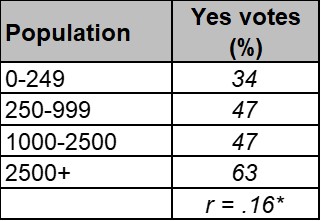
Table 1


Only 34 percent of voters in the smallest municipalities voted for amalgamation, while the percentage reached almost 50 in the larger units; that is, those with a population between 250 and 2500. The voters in the largest Icelandic municipalities were much more positive – 63 percent of them voted for amalgamations.

Another variable, “Relative size”, however, had even stronger explanatory power than “Actual size”. The idea behind the construction of this variable was that it should be able to be an alternative measure of own municipality’s expected status in the new municipality, where a low percentage share meant that the municipality was very likely to receive the peripheral municipality role in the future municipality and in the same way that a high percentage share increased the probability that the municipality would receive a central role.[9] In municipalities with a population of less than 15 percent of the total population in the proposed amalgamated municipality, only 34 percent voted for amalgamation. In municipalities with a population of 15-50 percent, the rate was 46 percent, and in those with more than 50 percent of the population, the pro-votes were 70 percent. An analysis of a 1994 survey conducted among all local leaders in the country reveals the same pattern in this respect, as was the result of the referendum a few months earlier.
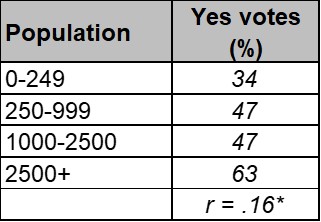
Table 2


This shows that center-periphery and large vs. small as well as relatively large vs. relatively small conflict lines were apparent. A good majority of the smallest and relatively smallest were rural communities in the periphery.

Left-right cleavages were less visible even though the initiative for amalgamation reform came from a social democratic minister. In a 1994 survey of Icelandic local leaders, they were asked several questions about amal­gamations.[10] A “For and against amalgamation-index” was constructed from their answers. When the scores are analyzed by party affiliation, we see in Table 3 that local leaders on the left wing (People’s Alliance and Social Democrats) scored at that time higher than others on the index.
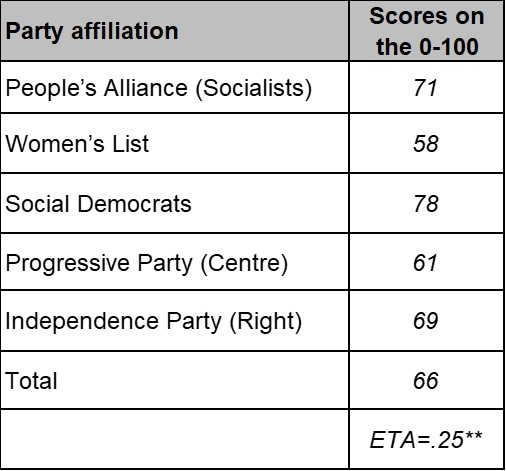
Table 3


This shows some differences between left and right in answers to the question. Leaders affiliated with or supporting the two parties to the left (People’s Alliance and Social Democrats) had the highest scores on the index shown (71 and 78).[11] However, efficiency and capacity seemed to dominate the pre-arguments and were to some extent linked to the provision of welfare state services. The strategy of the Ministry to try to convince people at meetings caused widespread opposition, and it was also apparent that leaders and people in small and relatively small municipalities were skeptical and opposed to this very top-down-oriented reform (Eythórsson, 1998).

2.2.3.   Outcome

If all submitted proposals had been accepted, it would have meant a drastic reduction in the number of municipalities in Iceland – from 196 to 43. But the referendum turned out to be a great disappointment for the pro side. Only one of the 32 proposals was accepted in all municipalities involved in these referendums. Only 67 out of the 185 municipalities involved voted for amalgamation. This only resulted in a direct reduction of municipalities by three. Nevertheless, a process never known before and hardly expected at that time was about to start. The intended reform had crashed, and the “expected” comprehensive reinforcement of the municipal level was not realized. However, two amalgamations due to the so called 2/3 rule in the Local Government Act reduced the number by 8. Other voluntary amalgamations´, plus two compulsory ones, lowered the number of muni­cipalities to 171 when it came to the Local government elections in the spring 1994. This two-thirds rule, established in connection with the 1993 referendums, allowed municipalities to amalgamate if accepted by two-thirds or more of the total number involved in a specific amalgamation proposal. In such a case, amalgamation was merely a matter of decision for the local councils.[12] So, the amalgamations in the winter of 1993-1994 reduced the number by 25. But there was more to come in the years that followed.

2.2.4.  Aftermath

By the next Local government elections, in 1998, the number of municipalities had shrunk to 124 and decreased further to 104 in the in the elections 2002. The process that began in 1993 led to a reduction of municipalities by 47 percent in only eight years, mostly through voluntary amalgamations. I want to try to elucidate this with the following explanations:[13]

  1. The so-called two-thirds rule established in the 1991-1993 reform allowed municipalities to amalgamate if two-thirds or more of the total number involved in any specific amalgamation agreed to such a proposal.
  2. The transfer of responsibility for primary schools from the state to the local level in 1996 caused extensive fiscal problems for some of the smallest municipalities, encouraging them to reconsider amalgamation. This was, for example, one of the drivers for mergers in the region of Skagafjörður where 11 municipalities amalgamated into one after referendums in the autumn of 1997 (Eythórsson, 1998; Eythórsson & Jóhannesson, 2002; Hlynsdóttir, 2001).
  3. With a few exceptions, the initiative for the amalgamations came from below – from the municipalities and not from the state authorities. This seems to have been a more efficient method than top-down initiated referendums.

It can be argued that the comprehensive debates, discussions, and research work leading up to the 1993 referendums served as a wake-up call for many municipalities. It became increasingly difficult for many small units to provide the services needed. The transfer of the primary schools from the state to the local level played a role there. So, taking indirect effects into account, we can conclude that the 1991 – 1993 territorial structural reform in Iceland was not a total failure. But the problem with the numerous small municipalities remained.

2.3.       The 2005 referendums

2.3.1.   Implementation – Strategy

In 2003, the Icelandic Ministry of Social Affairs[14] launched a reform project to strengthen the municipal level in co-operation with the Association of Local Authorities, which is said to have taken the initiative to push a new minister to start the reform. An Amalgamation Commission was set up to lead the program. The primary objective of the reform was to strengthen municipalities so they could better provide their current services and eventually take on new ones. Bringing this about would make it possible to move public services from the state to the local level. This required a reassessment of the division of tasks between the state and the local level, as well as a revision of local government finances. But the cornerstone of the project, however, was to strengthen the local level by amalgamating smaller municipalities. As referred to above, even though the number of municipalities had been reduced by almost 50 percent since 1993, the reform commission argued that this had not changed the main characteristics of the municipal structure – many very small municipalities still existing, lacking the capacity to take over more responsibilities from the state as part of the reinforcement strategy.

The commission presented its objectives in a 2004 report:[15]

  1. That municipal structure should match the functional labour market and service areas.
  2. The municipalities should be capable of performing their statutory duties without cooperating with other municipalities.
  3. That municipal administration should be professional.
  4. That the municipalities were capable of taking over more tasks from the state.
  5. That municipal finances and economy were based on a firm footing.

Special commissions on financial matters and on the division of tasks were set up to handle those parts of the reform.

As before, all amalgamations were voluntary by law; referendums were to take place in 66 municipalities out of a total of 97 in the spring of 2005. In these 66 municipalities, residents voted on a total of 17 merger proposals, so a “yes” to all would have reduced the number of municipalities to 49. The general commission on financial matters did not agree on its mandate in time, and many local leaders claimed that the time for arguing the case was too short, so the referendums were postponed until October. However, five of these 66 municipalities wished to move ahead right away and vote on amalgamation, since they had completed all their preparations. This was in the Borgarfjörður region, and the referendum was held in April 2005. Referendums were held in 61 municipalities on October 8, where the people voted on 16 different amalgamation proposals. The Minister of Social Affairs had expressed his wish to reduce the number of municipalities to 40-50 through such voluntary amalgamations, even though it was well known beforehand that there was a widespread popular resistance in many municipalities (Eythórsson, 2009).

This time, the initiative came not only from above, from the state; it was also endorsed by the Association of Local Authorities. Whether that should be considered as a top-down initiative is a matter of opinion, since the motivating force comes from both above and below. This calls for some explanations as to why the Association of Local Authorities in Iceland has repeatedly initiated or supported amalgamation reforms while at the same time a large majority of its member municipalities has opposed them. The answer concerns the Association’s organizational structure. Representatives in the Association’s decision-making organs were chosen in proportion to population size; thus, the larger municipalities gained more representatives. This has been the situation ever since 1945 and still applied at the time of the referendums we are examining. Since the attitude towards amalgamation has always been more positive in the larger municipalities, the decision-making structure in the Association has meant that the official standpoint has been positive. At the same time, the law states that each municipality must accept an amalgamation in a referendum. This mismatch explains the different standpoints on the amalgamation question over the years.[16]

2.3.2.   Conflicts

The objectives and strategies behind this reform were very similar to those applied in the 1991-1993 reform. The main goal was to eliminate units that were too small to be able to accomplish their tasks properly and professionally. Thus, it comes as no surprise that the conflict pattern was similar to that of the former reform. The reform in 2003-2005 is less documented than the 1991-1993 revision, but an analysis of the results in the 2005 referendums shows very similar patterns to those of 1993: As was the case in 1993 the resistance to the reform was much stronger in smaller and proportionally smaller municipalities – in general in the periphery rather than in the towns and population centres. This is shown in Tables 4 and 5:
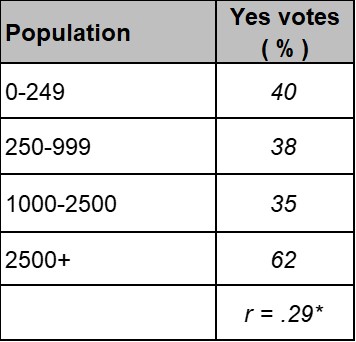
Table 4


The difference between the municipalities with a population of more and less than 2500 is clear. The support for amalgamations was significantly stronger in the largest units. The same pattern is also apparent when looking at relative size – in units containing more than half the suggested population – the support was stronger among those destined to be big brother in an anticipated municipality.
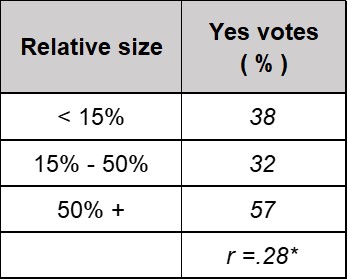
Table 5


No data has been collected on citizens’ attitudes towards amalgamation by party affiliation. We saw that the 1993 reform was initiated by a social democratic minister, Jóhanna Sigurðardóttir (Alþýðuflokkurinn), and that local leaders to the left were more likely to support amalgamation. In the 2005 case, the government initiative came from the center party minister Árni Magnússon (Framsóknarflokkurinn) and not from the left side. Therefore, no explanations on a left-wing bias can be made for the 2005 instance.

2.3.3.   Outcome and aftermath

Referendums took place in 66 municipalities in the spring and autumn of 2005. In these 66 municipalities, residents voted on 17 different amalgamation proposals. ‘Yes’ to all proposals would have meant a reduction of 49 municipalities, down to 48 in total. A referendum in the Borgarfjörður region (5) was held on the 23rd of April, and in the other 61 regions on 8th October. The 17 different proposals did not receive the necessary support in 42 municipalities but were accepted in 24. This was of little use, since only one proposal was accepted as a whole – that is, by a majority in every municipality in question. This was in East Iceland. Thus, the outcome was a reduction of three municipalities, from 92 to 89. In several cases, municipalities that had voted ‘yes’ voluntarily continued the process, based on the 2/3 paragraph. At the time of the Local Government Elections in May 2006, the number of municipalities was down to 79.

An evaluation report on the 2003 – 2005 reform suggests some conflicts connected to implementation and strategy. Five main reasons for the limited results of the reform are mentioned (Stjórnsýsluráðgjöf, 2008, p. 4-5):

  1. Preparations were inadequate since important questions on the division of tasks and revenues were never answered.
  2. The implementation and presentation of the reform were authoritarian – orders from above.
  3. The methodology was wrong because initiative from below would have been necessary.
  4. The reform lacked political support at the state level.
  5. Fear of change was widespread, and many stories of the negative impact of amalgamations affected the voters.

Subsequently, development has been slow in municipal amalgamations in Iceland. As shown in the following table, the number did not decrease more than 15 between 2006 and 2022. This we see in table 6.
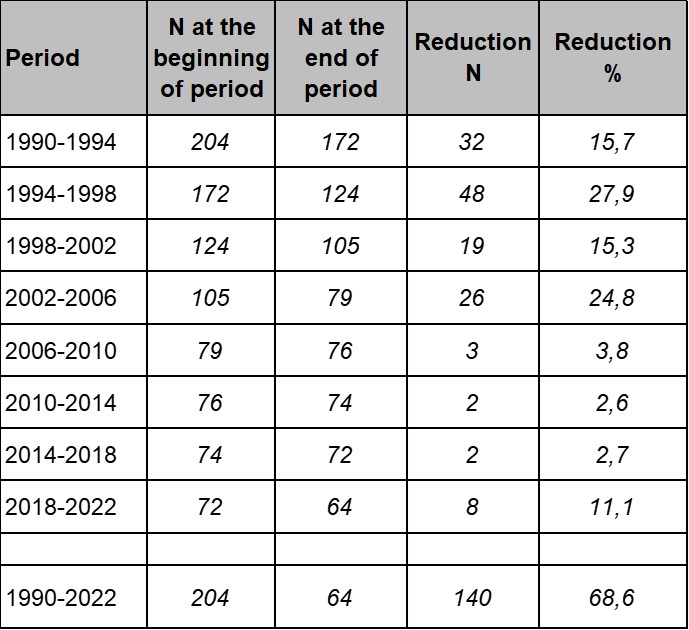
Table 6


We can see the period 1990 – 2006 as a phase of significant reduction in the number of municipalities in Iceland. This was primarily achieved by voluntary amalgamations. So far, the objectives and goals behind the efforts that led to the two reforms have not been reached.


3.     Concluding discussion

The initiative for the 1991-1993 territorial reform, with the referendums in November 1993 as a final point, came first and foremost from the Minister of Social Affairs, Jóhanna Sigurðardóttir. The set-up was a comprehensive reform, although not all-embracing, since 185 out of 196 municipalities were included – 11 were not. The Association of Icelandic Local Authorities formally supported the reform. The strategy was strongly top-down, as bureaucrats and experts hired by the Ministry travelled around the country to convince people of the advantages of amalgamation. However, as the Act on Local Government in Iceland is, and always has been, it is clear that all amalgamations must be voluntary. The success of this reform was entirely dependent upon the results in the 32 different referendums, with voters in 185 municipalities involved. So, even though it was top-down-oriented, it was all about the ability to convince and influence. The 2003 – 2005 reform had less top-down orientation since the initiative came as much from the Association of Local Authorities as from the state government. Furthermore, it was not as comprehensive as the former endeavor in 1993, since only 68 percent of the municipalities were included this time, compared with 94 percent in the previous decade. In both reforms, the lines of conflict were apparent and very similar. Central-periphery and Big-small cleavages were present, as we see in the tables above, where the results from both referendums are analyzed.

In both referendums, resistance was significantly stronger in the smallest units and, in proportional terms, even stronger in the proportionally smallest communities. The conflict pattern was clear. The top-down orientation, especially in 1993, seems to have contributed to resistance only in these municipalities. In both cases, the immediate results of these two referendums were limited.

However, in subsequent years, things began to move on, and this was followed by quite a number of voluntary amalgamations. I have concluded that the comprehensive debates, discussions, and research work leading up to the 1993 referendums worked as a wake-up call for many of the smaller municipalities. Difficulties that many small communities faced in providing the obligatory services and the services needed, as well as the transfer of primary schools to the local level, played a role in the 1990s case. Therefore, the 1991 – 1993 territorial reform in Iceland cannot be considered a total failure. The number of municipalities went down from 196 to 105 between 1993 and 2002. But the problem persisted with the relatively numerous small municipalities lacking economies of scale and capacity.  Neither the 2005 referendum nor its aftermath changed that pattern.

If we, finally, try to conclude whether these two reforms were top-down or bottom-up oriented, comprehensive or incremental, that is, whether they were in Jacobin– or Girondin style, there is no short or simple answer.

The reforms were top-down initiated and with top-down-oriented strategies. However, since amalgamations are by law voluntary and because of the already explained mismatch in the decision-making structure of The Association of Icelandic Local Authorities, any enforcing method to push this through is impossible, with or without the support from the Association. Both reforms were quite comprehensive, aimed primarily at eliminating the small municipal units, and should be considered as a mix of the Jacobin and Girondin strategies.


4.     References

Baldersheim, H. & Rose, L. (2010). Territorial Choice: Rescaling Governance in European States. In Baldersheim, H. & Rose, L. (Eds.) (2010), Territorial Choice. The Politics of Boundaries and Borders (pp.1-21). London: Palgrave Macmillan.

Baldersheim, H. & Rose, L. (2016). Territorielle Styrningsstrukturer og –Reformer i Europeisk Perspektiv. [Territorial Management Structures and Reforms in a European Perspective]. In Klausen, J. E., Askim, J. & Vabo, S. I. (Eds.) (2016), Kommunereform i Perspektiv. Bergen: Fagbokforlaget.

Bjarnason, T. & Heiðarsson, J. T. (2013). Útgjöld ríkisins í Norðausturkjördæmi og tekjur ímyndaðs „Norðausturríkis“. [State expenditure in the Northeast district and the income of a hypothetical sovereign Northeastland]. Stjórnmál og stjórnsýsla, 9(1), 155-170. http://hdl.handle.net/1946/16040

Bjørklund, T. (2013). Politisk deltakelse i sentrum og periferi. Kontraster og endringer. [Voter turnout in centre and periphery. Contrasts and changes]. In J. Bergh a & D. A. Christensen (Eds.), Et robust lokaldemokrati – lokalvalget i skyggen av 22. juli 2011[Strong local democracy –  municipal elections in the shadow of 22 July 2011] (pp. 165-178). Oslo: Abstrakt forlag AS.

Blom-Hansen, J. Houlberg, K. & Serritzlev, S. (2016). Hurtig, Ufrivillig og Omfattende: Den Danske Kommunereform [Quick, compulsory and comprehensive. The Danish municipal reform]. In Klausen, J., Askim, J., & Vabo, S. (Eds.), Kommunereform i perspektiv (p. 203-228). Oslo: Fagbokforlaget.

Brantgärde, L. (1974). Kommunerna och kommunblocksbildningen [Munici­palities and municipal amalgamation]. Göteborgs Studies in Politics 4.

Broekema, W., Steen, T., & Wayenberg, E. (2016). Explaining Trajectories of Municipal Amalgamations: A Case Comparison of the Netherlands and Flanders. In S. Kuhlmann & G. Bouckaert (Eds.), Local Public Sector Reforms in Times of Crisis. National trajectories and international comparisons (pp. 43-58). London: Palgrave MacMillan.

European Charter of Local Self-Government. https://rm.coe.int/CoERMPublicCommonSearchServices/DisplayDCTMContent?documentId=090000168007a088

Eythórsson, G T (1998). Kommunindelningspolitik i Island. Staten, kommunerna och folket om kommunsammanslagningar.[Municipal structure in Iceland. The state, the municipalities and the people on municipal amalgamations] Göteborg. CEFOS.

Eythórsson, G T (2003). Af smáum sveitahreppum og stöndugum kaupstöðum. Um þróun sveitar­stjórnarstigsins á Íslandi. In: Afmæliskveðja til Háskóla Íslands. Hólar, Akureyri 2003. 

Eythórsson, G T (2009). Municipal amalgamations in Iceland. Past, present and future. In: Baldacchino, Greenwood & Felt (eds.): Remote Control. Governance Lessons for and from Small, Insular, and Remote Regions. St. John´s. Iser Books.

Eythórsson, G T (2012). Efling íslenska sveitarstjórnarstigsins. Áherslur, hugmyndir og aðgerðir. (Reinforcing the municipal level in Iceland. Ideas, policies and implementation). In: Stjórnmál og stjórnsýsla. (Icelandic Review of Politics & Admininstration) Vol. 2. No 8. 2012. (431-450) http://www.stjornmalogstjornsysla.is/?p=1178

Eythórsson, G T (2014). Sameining sveitarfélaga á Íslandi í 70 ár. Röksemdir sameiningarsinna og andstæðinga. (Municipal Amalgamations in Iceland in 70 years). In: Stjórnmál og stjórnsýsla. (Icelandic Review of Politics & Admininstration) Vol 1. No 10. 2014. (143-168). http://www.irpa.is/article/view/a.2014.10.1.8/pdf

Eythórsson G T and Jóhannesson H (2002). Sameining Sveitarfélaga. Áhrif og Afleiðingar. Rannsókn á 7 sveitarfélögum. Akureyri. RHA.

Félagsmálaráðuneytið (1991). Skipting landsins í sveitarfélög 1. Tillögur og greinar­gerð. Áfangaskýrsla I Nefnd um skiptingu landsins í sveitarfélög. [Commission on the Division of the country into municipalities 1. Proposals and report. Intermediate Report I]. Reykjavík: Félagsmála­ráðuneytið.

Félagsmálaráðuneytið (1992). Aukið hlutverk sveitarfélaga. Áfangaskýrsla sveitar­félaga­nefndar [Increased role of municipalities. Intermediate report by the Commission on the Division of Municipalities]. Reykjavík: Félagsmála­ráðuneytið.

Félagsmálaráðuneytið (2004). Átak um eflingu sveitarstjórnarstigsins Fyrstu tillögur nefndar um sameiningu sveitarfélaga. [Initiative for strengthening the municipal level. First proposals by the Commission on the Division of Municipalities] Reykjavík: Félagsmálaráðuneytið September 2004:1.

Hlynsdóttir E M (2001): Sveitarfélagið Skagafjörður. Staða lýðræðis í sam­einuðu sveitar­félagi [Skagafjörður Municipality. The democratic situation in an amalgamated municipality]. BA-thesis from the University of Iceland.

Kaiser C (2014). Functioning and impact of incentives for amalgamations in a Federal State: The Swiss case. International Journal of Public Administration, 37(10), 625-637.

Kaiser C (2015). Top-down versus bottom-up: Comparing strategies of municipal mergers in Western European Countries. dms-der moderne staat 1: 113-127.

Klausen J E, Askim J & Vabo S I (2016). Kommunereformen i Norge. In: Klausen J E, Askim J & Vabo S E (eds.). Kommunereform i perspektiv. Fagbokforlaget 2016. (25-46).

Lög um breyting á Sveitarstjórnarlögum nr. 8/1986 (8/5 1993) [Act to Amend the Municipalities Act ].

Lög um sameiningu sveitarfélaga nr. 70/1970. [Act on the Amalgamation of Municipalities]

Rokkan, S & Urwin D W (1983). Economy, Territory, Identity: Politics of West European Peripheries. Sage Publications.

Samband Sveitarfélaga. Niðurstöður atkvæðagreiðslu um sameiningu sveitarfélaga 8. október 2005 [Icelandic Association of Local Authorities. Results of a referendum on municipal amalgamation 8 October 2005] Retrieved from: http://www.samband.is/media/sameining-sveitarfelaga/Nidurstodur-atkvaedagreidslu-um-sameiningu-sveitarfelaga-2005.pdf

Samband Sveitarfélaga. http://www.samband.is/um-okkur/landsthing-sambandsins/

Steiner, R., Kaiser, C., & Eythórsson, G. T. (2016). A Comparative Analysis of Amalgamation Reforms in Selected European Countries. In S. Kuhlmann & G. Bouckaert (Eds.), Local Public Sector Reforms in Times of Crisis. National trajectories and international comparisons. London: Palgrave MacMillan.

Stjórnsýsluráðgjöf (2008). Átak um eflingu sveitarstjórnarstigsins. Unnið fyrir Samgöngu­ráðuneytið. Reykjavík. [An evaluation report on the 2003-2005 territorial reform].

Strömberg, L. & Westerståhl, J. (1984). The New Swedish Communes. A summary of local government research. Lerum: Lerums Boktryckeri.

Strandberg U (1995). Självständighet eller statsbundenhet. Den kommun­ideologiska idédebatten 1962-1974. CEFOS. Göteborgs Universitet.

Sveitarstjórnarlög nr. 58/1961. [Municipal Act]

Sveitarstjórnarlög nr. 8/1986. [Municipal Act]

Sveitarstjórnarlög nr. 138/2011. [Municipal Act]


Endnotes

[1] See Eythórsson (2009), Eythórsson (2012) and Stjórnsýsluráðgjöf (2008).

[2] This is explained in more details in Eythórsson (1999) in chapter 9.3 p. 126ff.

[3] The European charter on local self-government (Article 5). https://rm.coe.int/CoERMPublicCommonSearchServices/DisplayDCTMContent?documentId=090000168007a088

[4] Sveitarstjórnarlög nr. 58/1961. Sveitarstjórnarlög nr. 138/2011.

[5] Lög um sameiningu sveitarfélaga nr. 70/1970.

[6] Sveitarstjórnarlög nr. 8/1986.

[7] At that time The Ministry for Social Affairs was responsible for municipal affairs.

[8] The commission was called “Nefnd um skiptingu landsins í sveitarfélög”. [Commisson for the apportionment of the country into municipalities].

[9] This is explained in more detail in Eythórsson (1999) in chapter 11.4, p. 162.

[10] The survey was conducted by Göteborg University; that is, by the author of this article during his doctoral studies.

[11] Amalgamation reforms in Sweden have historically been driven by parties on the left spectrum of politics. In Norway, amalgamationms have rather been driven by the right-wing (Klausen et al. 2016; Strandberg, 1995).

[12] Lög um breyting á Sveitarstjórnarlögum nr. 8/1986 (8/5 1992).

[13] See also in Eythórsson, 2009.

[14] At that time the Ministry of Social Affairs was responsible for the local government affairs. At the time of writing this belongs to Ministry of Infrastructure.

[15] Félagsmálaráðuneytið (2004).

[16] This is shown with data in Eythórsson (1998, p. 41-43).
Local Democracy in the West-Nordic Countries

The geographical structure of people’s settlement in the three West Nordic countries, The Faroe Islands, Greenland and Iceland is in itself a considerable challenge for the provision of municipal services. It can be argued, therefore, that this can be a challenge for the democracy at the local level. The municipal structure varies in the three West Nordic countries and has changed in the past decades. Geographically the three countries are quite different although the similarities are more obvious when we look at the economic structure – fishing and fish processing are the mainstay of the economy. It can be argued that local communities in the West Nordic countries are facing a certain type of dilemma. On the one hand, decisions at local level need to be based on sound knowledge of local circumstances and conditions and taken in harmony with the local people, if they are to be sensible, successful and legitimate decisions. On the other hand, very small or “too” small local decision-making units often have problems mobilizing and providing the expertise needed to make rational decisions – something that can be called a capacity problem. The problem, or question, on the optimal size of a municipality – or should we rather say optimal smallness – is a relevant and emerging question in, for example, the four larger Nordic countries. But the difference between the West Nordic and the East Nordic (Scandinavian) situation in this sense is that the countries and the municipalities in the west are historically much more smaller in population.

In 2012, the research project West Nordic municipal structure. Challenges to local democracy, efficient service provision and adaptive capacity was granted money from the Arctic Co-operation Programme 2012-2014. The overall aim of the project was to collect knowledge on the local level in the three West Nordic countries; the Faroe Islands, Greenland and Iceland by mapping the situation and development in the municipal sectors, focusing primarily on four aspects. The first was; the municipal structure. The second was; the democratic aspect – that is, which consequences the structural development has had for local democracy – to identify the main challenges to democracy, caused by the structural developments. The third; to map the service production capacity and effectiveness of the municipalities, and the fourth; to try to map the municipalities’ capacity to manage the development processes which often accompany municipal amalgamations. An overall research question was: What consequences have developments in municipal structure in the three countries had for democracy, local self-government and autonomy, as well as the ability to manage the processes accompanying amalgamations? In September 2014 a report containing this analysis was submitted (Eythórsson, Gløersen and Karlsson 2014).

In a second phase of the project, the project team tried to develop and deepen the insight into these matters by undertaking a survey among all elected local politicians and chief administrators (mayors) in all of the municipalities in the three countries[1]. In the survey there were asked questions aimed at deepening our understanding of the problems and challenges facing the municipal level in the three countries, with a special focus on the findings of the earlier mentioned report from 2014. The survey contained among others some questions focused on local democracy as such as well as its development after amalgamations that have been taking place since year 2000 or so (Eythórsson, Gløersen and Karlsson 2015).

In this article I use the data from this survey to answer following main research questions:

  1. What is the general status of local democracy in the three countries?
  2. Is there a connection between size and democracy when we are looking at municipalities in a small scale size as is the case in the West Nordic countries?
  3. Does peripheral or central position in a municipality affect the attitudes towards democracy as measured in the survey reported?

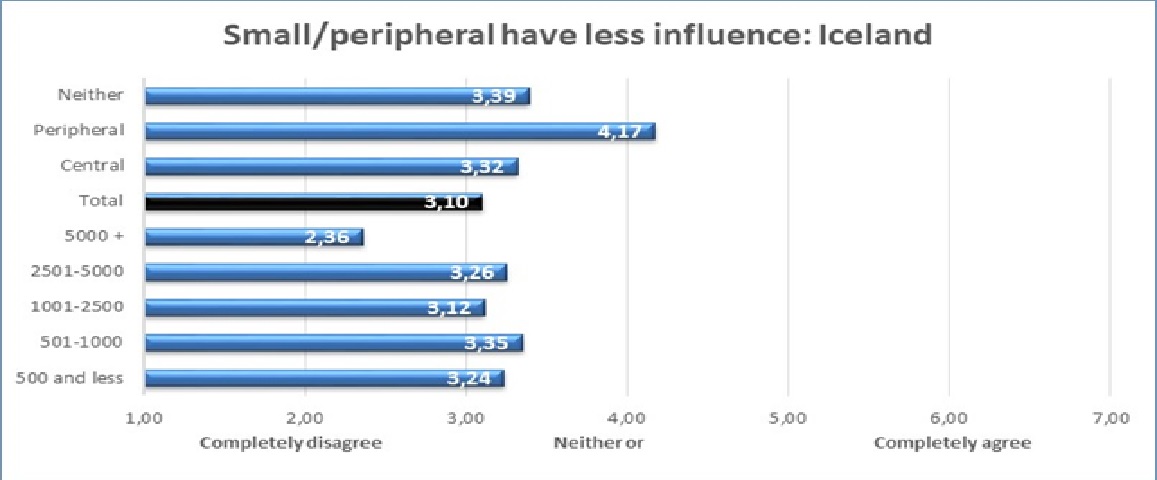
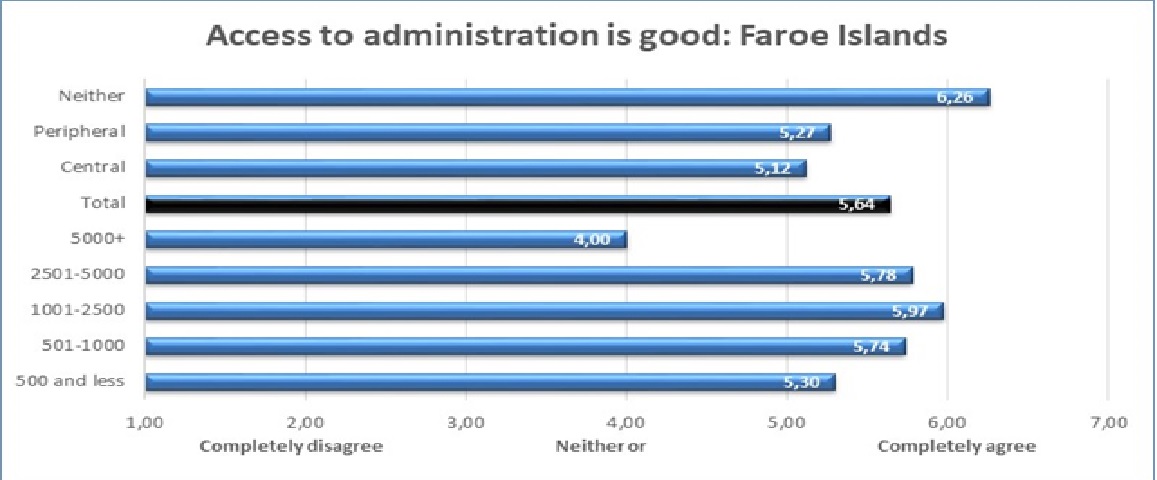
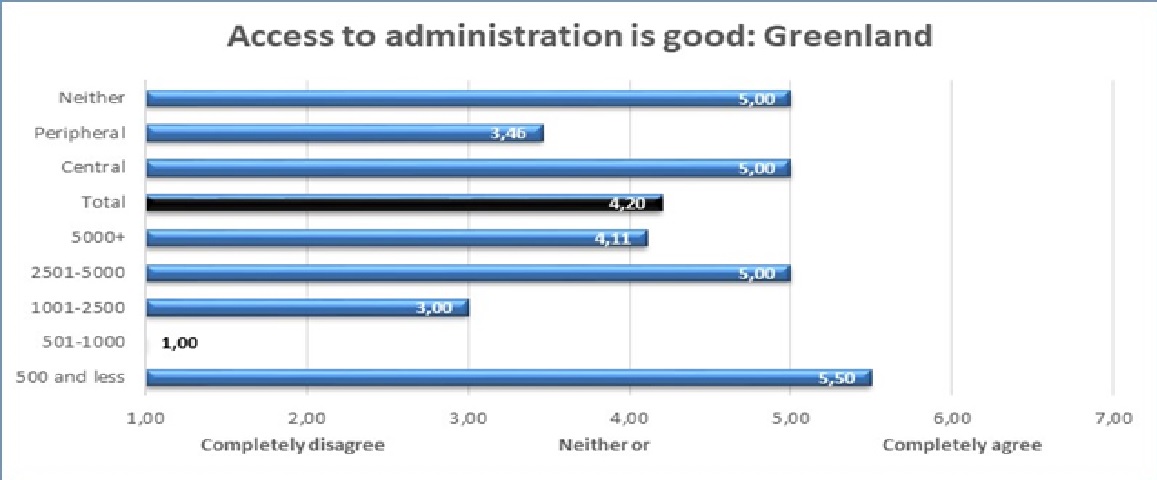
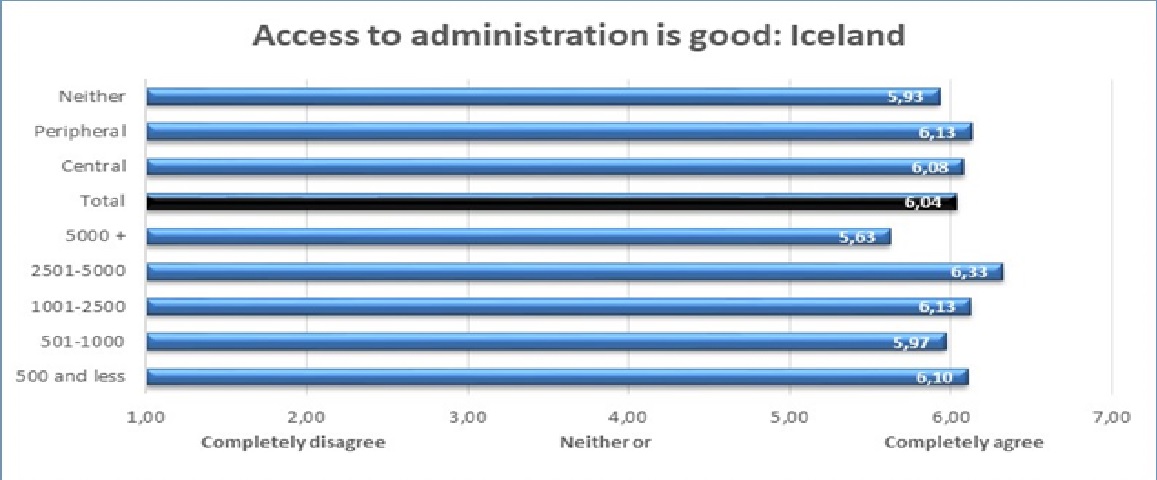
The operationalization of local democracy is threefold: First, looking at the perception of power and influence by different territories in each municipality. Second, looking at the perceptions of access to the municipal administration. The third is by looking at the perception of ties and contacts to the local politicians.


1.             Municipal amalgamations and the impact on democracy

When taking territory into consideration; that is, in this case territory within municipal boundaries, there are different views on democratic aspects such as equality between parts of the municipality or neighbourhoods. The main idea is that citizens in more peripheral, with less population and/or more sparsely populated parts of the municipality are at a disadvantage for influencing decisions, making contact with the elected officials and, in general, find it more difficult to access the administration, compared with those living in, or close to, the central area of service and administration.

This general assumption is often linked to municipal amalgamations where two or more municipalities merge into one, despite different population structures, varying degrees of peripherality and different preconditions for acting as centres for administration and service. In these cases, there are winners and losers. The largest units usually attain a central role while the smaller ones and those more distant from the centre have to live with the fact that they are peripheral with a view to administration and services. Both Swedish and Icelandic studies have shown the fear or scepticism of people and local politicians in prospective peripheries facing amalgamations with this upcoming situation (Brantgärde 1974, Eythórsson 1998, Steiner et al. 2016). The expected power position of people’s current municipality within the proposed new one has clearly shown to be the strongest explanatory factor for attitudes towards amalgamations, both in the Swedish and the Icelandic case. Those residing in the expected administrative and service centre of a new municipality are likely to be much more positive than those residing in the municipalities that are not going to occupy that role. People in the administrative and service peripheries are clearly less interested in amalgamating with the big brother who is expected to consolidate power and use that to its own advantage. This resistance is strongest in the bigger peripheries, often municipalities who have had their own administrative structure, which has not always been the case in many of the small rural municipalities in Iceland. In that way, the big ‘losers’ have more to lose and thus manifest more resistance in many cases. This means that the correlation between municipal size and attitudes to amalgamations is not always linear: the relationship is more complicated since the possibilities of being the centre have more to do with proportional rather than absolute size.

An evaluation study in Iceland by Eythórsson and Jóhannesson (2002) in 37 municipalities which were amalgamated into 7 in the 1990s showed clear democratic deficits for the smaller and peripheral and gives support to the results from the former Icelandic and Swedish studies. There was considerably more discontent with democratic aspects and administrative structures among people and local leaders in the parts or neighbourhoods of municipalities that had now become the smaller and more peripheral neighbourhoods of a new amalgamated municipality. All the municipalities surveyed showed that people outside ‘central places’ defined as the proportionally biggest municipality, that became the centre of administration and services after the amalgamation – felt that they were now more distant from their political representatives than before and thereby their opportunities to influence and lobby decisions were much more limited. Furthermore, the majority of the people living in the periphery believed that political power was now concentrated in these ‘central places’ (See in Eythórsson 2009 and Eythórsson 2011).

In 2006, just before the great municipal reform in Denmark, Danish political scientists published the anthology Kommunalreformens konsekvenser (Blom-Hansen, Elklit and Serritzlew 2006). The results show a clear negative correlation between the size of a municipality and several indicators of democracy, such as trust, voting participation and attending political meetings (Juul-Madsen and Skou 2006).[2] In another study presented in this book Nørgaard-Petersen and Christensen did not find any correlation between municipal size and representation – that is, in bigger municipalities, voters in various social groups used their potential for participating in the democratic process (Nørgaard-Petersen and Christensen 2006). Lassen and Serritzlew (2011) conducted research on the correlation between jurisdiction size and local democracy. Using the Danish structural reform as a case they looked for evidence on internal political efficacy. By internal political efficacy they mean that citizens believe they are competent to understand and contribute to political decision making and by external political efficacy they mean that citizens feel government authorities are responsive to their demands so that participation is something worth struggling for. Among their findings was that in terms of population larger municipal units were necessary for economies of scale but at the same time larger size incurred cost with regard to the quality of democratic order (Lassen and Serritzlev, 2011).

These examples of research on democracy and the impact of structural reforms show that structural territorial reforming by enlarging municipal units is, at the same time, a question of the balance between economies of scale and local democracy – both when citizens and local politicians are asked. These studies have mostly shown us that too much emphasis on seeking economies of scale can have negative consequ­ences for the local democracy. This is in line with what was argued already in 1973 by Dahl and Tufte, that correlation between size and democracy exists.

However, looking at the research examples from Denmark we have to realize that in that case the question was about much larger municipal units than in the case of the West Nordic countries – this even though we are talking about the newly amalgamated Greenland municipalities.


2.             Municipal structure in the West Nordic countries – A short overview
2.1.        Faroe Islands

Already in the mid-twentieth century there were 49 municipalities in the Faroe Islands, an autonomous territory of 18 islands with a population of less than 50,000. This structure of numerous small municipalities, with more than half of them having a population of less than 1000, stayed the same all the way into the beginning of the 21st century. The Faroese municipal geography during this period is summarized by Hovgaard et.al. (2004) as following:[3]

  • A capital with more than 40% of the population
  • Constantly improving conditions for commuting to the capital of Tórshavn have connected over 85% of the nation by road
  • A rather peripheral island of Sandøy in the south with a little over 1200 inhabitants and four municipalities
  • The even more peripheral Island of Suðuroy, 2:15 hours ferry trip from Torshavn. On Suðuroy there are 7 municipalities with a total population of around 4600
  • Geographically remote small islands (municipalities) with low population and difficult communications

Despite massive resistance against law-enforced reform, voluntary amal­gamations in the beginning of the 21st century reduced the number of municipalities from 49 in 2000 to 35 in 2005. Early in 2008 a new government came to power and the coalition paper contained clear statements on the municipal structure. “Regional development initiatives and changes in the municipal structure shall ensure fair and balanced opportunities for all areas of the Faroe Islands.” Furthermore, the coalition paper contained statements on deadlines by which municipalities should have grouped into suitable entities that were able to take over more tasks from the state government – and this would ensure even standards of services in the whole country (Aalbu et. al. 2008).

Prime Minister Jóannes Eidesgaard, said in his opening speech to the parliament (Løgtinget) in July 2008, where he said that the government had decided to reduce the number of municipalities to 7 during the mandate period. (Aalbu et. al. 2008). The government coalition broke up already in the autumn 2008 and these intentions have not yet become reality as other less interested parties have been in power since then.

The amalgamation issue was more or less put off in 2012 with a nationwide referendum on the people’s will to amalgamate, with the potential result that the number of municipalities might have gone down from 30 to 7. With only 33 percent voter turnout, this proposal did not receive majority support in any of the 30 municipalities.

Today the number of municipalities remains at 29 – the radical intentions of the 2008 government were never realised as the people of Faroe Islands refused. And people seem to think that this amalgamation wave of the first decade of the 20th century has come to an end. “The referendum stopped everything” and “The reform is dead” were the answers the authors of this report received from interviews with people from the federation of municipalities in the Faroe Islands. However, if we look at what has happened since year 2000 we see a reduction of municipalities by almost 40% – so the change is noticeable even though the municipal structure characteristics remain the same: Fewer very small and more rather small municipalities. Only one amalgamation has taken place since 2009 when Húsa amalgamated with Klaksvík in 2017.


2.2.        Greenland

When the home rule system was established in 1979 the 18 municipalities in Greenland acquired a more central role in the domestic welfare system taking care of social services, culture, education, housing, planning, fire brigades, water and electricity (Dahl, 1986; Bærenholdt, 2007). In 2007 the Greenland Parliament directed the Greenland Home Rule to implement a new municipal structure for Greenland. This decision led to radical structural change when 18 municipalities were amalgamated to only 4. New municipal councils were elected in spring 2008 and established from May 2008. The change was formally implemented 1st January 2009. The rationale behind this development was set by the Structural Committee (Strukturudvalget). The main purposes were:

  1. To make all municipalities large enough to be able to take over more tasks from the Home Rule.
  2. To ensure that the citizens in the municipalities received better and safer services.
  3. To gain effectiveness and economies of scale in the municipal service provision.[4]

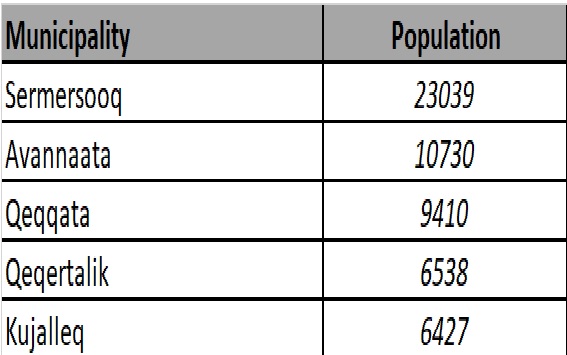
The number of municipalities was reduced in 2009 from 18 to 4 municipalities but from 1 January 2018 the municipality of Qaasuitsup was split in two: Avannaata and Qegertalik. Therefore, the municipalities in Greenland are five, as we see in table 1:


Table 1. Municipalities in Greenland 2019 and their population.[5]


With the largest municipality of over 20,000 inhabitants, two around 10,000 and the two smallest of around 6,500 the structure has changed dramatically.

In their report Administrative Reform – Arguments and Values, Aalbu, Böhme and Uhlin map and analyze the municipal structures, structural reforms and the arguments and values behind them, in all eight Nordic countries. They conclude that no clear public opposition to the reform process in Greenland emerged. Further, they conclude that the in the debate around the reform, the main focus was on efficiency, accessibility and quality in local administration. Thus they think the main emphasis in the Greenland case has been on effectiveness and improved services, just as in the cases of Sweden and Denmark.


2.3.        Iceland 

The main development pattern is that the number of municipalities in Iceland increased slowly until the middle of the 20th century, and then began to decrease, especially after 1990. The main reason for the increasing number of municipalities until the 1950s (229 at its peak) was the industrialization of fishing, leading people to move from the countryside to the coast in order to work where there were better hopes of earning a decent income. This meant that new fishing villages emerged, and new municipalities were established.[6]

A slow decrease was in the number of municipalities after the mid-twentieth century (204 in 1990) is mainly explained by two forces – a number of rural municipalities ceased to exist due to total depopulation; and some municipal amalgamations. The rapid changes since after 1990 were indirectly facilitated by two referenda on municipal amalgamations – one in 1993 and the second in 2005 – and their implications. The number was down in 124 in 1998 and is at present 72.

In November 1993, referenda were held in 185 municipalities out of 196. Had all the submitted proposals been accepted, they would have meant a drastic reduction in the number of municipalities, down to 43. However, every proposal except one was voted down in these referenda. Only 67 out of the 185 municipalities involved voted for amalgamations. This only caused an immediate reduction of municipalities by 3, but nevertheless the ball had been set rolling and an amalgamation trend never known before had started. By the time of the local government elections in spring 1994, several voluntary amalgamations among those that had voted ‘yes’ in the November 1993 referenda had already reduced the number of municipalities to 171. By the next elections in 1998, the number was reduced further to 124 and was as low as 105 in the local government elections in 2002. Thus, a process was initiated in 1993 which had led to a reduction of municipalities by as much as 47 percent in only 9 years (Eythórsson 2003. Eythórsson 2009, Eythórsson 2012).

In 2003, the Icelandic Ministry of Social Affairs launched a reform project on the strengthening of the municipal level, in cooperation with the Federation of Municipalities. The main objectives were to strengthen municipalities so they would be better able to pro­vide their current level of services and eventually some additional ones. Bringing about such a change would make it possible to move certain public services from the state to the local level. This required both a revised division of tasks between state and local level, as well as a revision of local govern­ment finances. The cornerstone of the project, however, was to strengthen the local level by amalgamating smaller municipalities. Even though the number of municipalities had been reduced by almost 50 percent since 1993 the project commission argued that this had not changed the characteristics of the municipal structure. Still there were far too many small municipalities lacking the capacity to take over more responsibilities from the state.

A referendum took place in 66 municipalities out of 97 in spring and autumn 2005. In these 66 municipalities, residents voted on a total of 17 merger proposals; so a ‘yes’ to all proposals would have meant a reduction of 49 in the number of municipalities. Referenda were held in April and October on 17 different amalgamation proposals. The 17 different proposals were voted down in 42 municipalities and accepted in only 25. This however led to immediate reduction of municipalities by 8.

No serious or extensive attempts to reform the municipal sector have been implemented in Iceland since 2005. Besides, interest in further amalgamation reforms seems to decline. Surveys among all elected local politicians in 2006, 2011 and 2015 show this. Interest and belief in amalgamations as a measure to strengthen the municipal level became significantly less than before. There is, as earlier, no majority support for law enforcement with regard to amalgamations.  Instead, local politicians showed increased interest in inter-municipal cooperation as the way to go further and take over more responsibilities from the state government (Eythórsson & Arnarson, 2012).

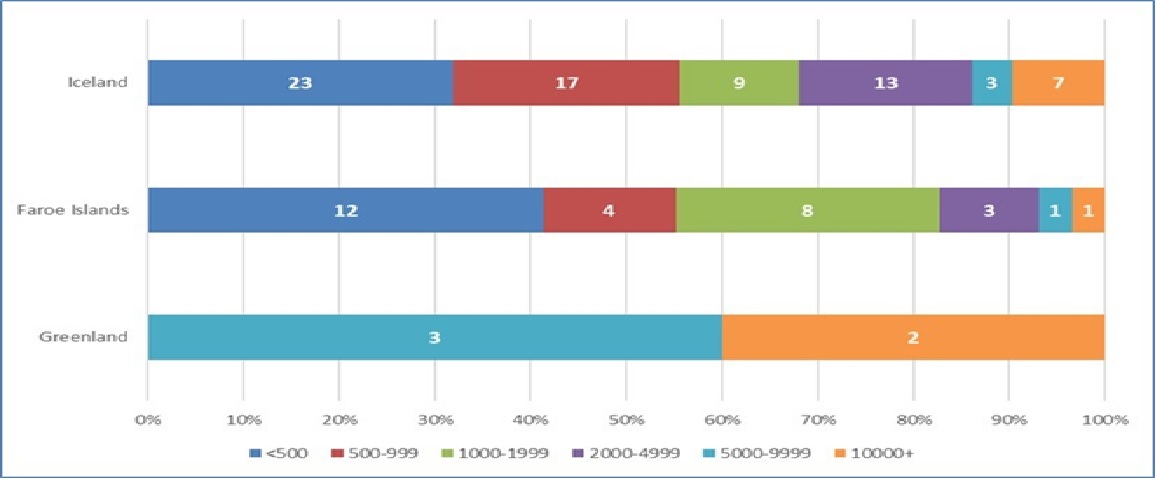
But in spite of all attempts to change, the main characteristic of the Icelandic system remains in the year 2019. More than half of the municipalities in the country have less than 1000 inhabitants and 1/3 has less than 500 (see Figure 1) – a trait which has been considered as the main problem through the decades; too many too small municipalities with limited capacity to provide modern services.


2.4.        The West Nordic municipal structure in sum

When attempting to sum up and compare the municipal structure in these three countries, the most striking fact is the dramatic development in Greenland, where the structure of local administration was changed after 2007 by amalgamating 18 municipalities to 4 (later 5). In this respect, the Greenland structure differs significantly from that of the Faroe Islands and Iceland. Now, Greenland has few and large communes, both measured in population and areal – at least in West Nordic terms. Even though bigger steps towards reforming the municipal structure have been taken in Iceland than in Faroe Islands, the characteristics are in principle the same. In both cases there are proportionally numerous very small municipalities with limited capacity to take over more welfare tasks and thereby provide modern services. In Iceland, however, there existed a will to strengthen the local level by other means than amalgamating after the referendums in 2005.

Figure 1 illustrates the municipal structure in the three countries at present:


Figure 1. Municipalities in the West Nordic countries in different size categories 2018.


It is clear that the share of small municipalities; that is, with a population of less than 1000, is similar in Iceland and the Faroe Islands, at 55 percent. At the same time municipalities of such limited size do not exist in Greenland anymore.

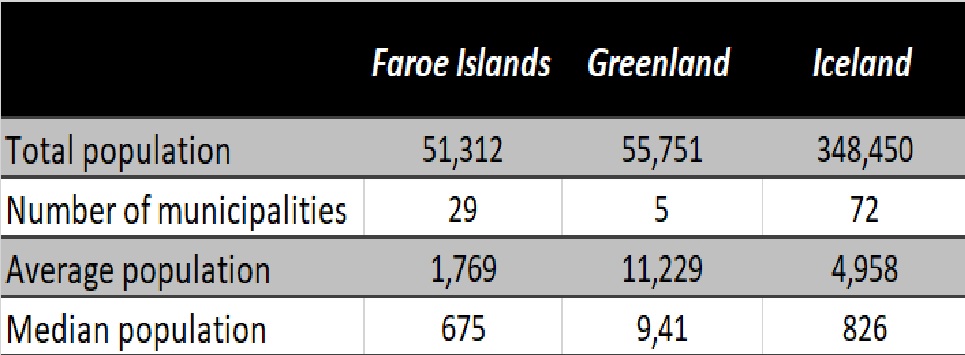
Table 2 provides an overview of some facts about the number of municipalities and their populations in the three West Nordic countries:


Table 2. Municipalities and their population in the West Nordic countries in 2019.

 (Based on data from: www.stat.gl, www.hagstova.fo, www.hagstofa.is)


There are, for example, significant differences between the three countries in the average size of municipalities. While Greenland has about 11,000, Iceland has almost 5,000 and the Faroe Islands just under 1,800. However, the average for Iceland is strongly affected by the size of Reykjavík with its 129,000 inhabitants. Therefore, the median scores give a better picture with the Faroes at 675 and Iceland at 826.


3.             Local democracy in the three countries
3.1.        Local democracy in the Faroe Islands

The coalition paper published by the 2008 government in the Faroe Islands contained clear policy statements on enlargements of the municipalities in order to increase their service capacity and ensure even service standards in the whole country. This was emphasized by Prime Minister Eidesgaard in Parliament in summer 2008 where he announced that the goal was to reduce the number of municipalities to seven. He underlined the democratic aspect in his opening speech to Parliament on the 29th of July 2008:[7]

An important part of democracy lies in decisions being made as close to the citizens as possible, and this is one reason why more and more functions are being transferred to the municipalities. (Translation from Danish)

These arguments of attracting young people to the more peripheral regions by transferring challenging tasks to the municipalities from the state were central in his speech. By this, Eidesgaard was in fact saying that the municipalities were too many and too small and had too limited tasks. In other words, local democracy, even though formally present, lacked content to be effective. This kind of argumentation has, for example, been presented in this context by Dahl and Tufte (1973) as well as by Harald Baldersheim (1987) who stated that it could of course be claimed that municipal amalgamations, which reduced the number of municipalities and thereby the number of local politicians, appeared to be a centralization of power. But such arrangements could actually prove to be a way to decentralize power, since an increased capacity for service provision also made local units capable of taking over more tasks from state level.

The emphasis in local democracy in the Faroe Islands was, according to this, clearly to make the units bigger and through that give the democracy some content. At the same time further amalgamations can increase the distance between the people and the politicians and even the distance to the administration, for some of them at least.


3.2.        Local democracy in Greenland

In a report to the Greenland Structural Committee (Strukturudvalget) in 2005 the Danish political scientist Ulrik Kjær pointed out what the consequences of the reform would be for local democracy in Greenland. He raised a warning flag as to the form of geographical representation in the new extensive municipalities, not at least due to the many instances of very difficult communi­cations between regions, villages and towns. In such a situation small and isolated places would suffer democratic deficits as peripheries in more than one sense. Kjær argued that it was very important, from a democratic point of view and with consideration to welfare services in the new municipalities, that smaller neighbourhoods should not lose all power within the new enlarged municipality (Kjær, 2005). Binderkrantz and Jacobsen (2007) also raised similar questions about the democratic aspect. According to them, increased costs, due to more travel between neighbourhoods in the new municipalities was to be met with a law on the use of videoconferences between isolated villages and neighbourhoods.

In the Annual Report 2011 of The Greenland Federation of Municipalities (KANUKOKA), local democracy is discussed in a separate chapter. It is stated that local democracy was not discussed broadly before the great amalgamations in 2009 – warnings from the scientists did clearly not get through. But in the report it is further stated that 3 years after the reform it is time to go deeper into that discussion. In the beginning of 2009 each of the four new municipalities was to establish a “geographical mandate” for every one of the former 18 municipalities. However, this was only to apply for the first four year mandate period. The annual report refers to hearings on experiences of this, conducted by the Ministry of the Interior. The hearing showed clearly that the mandate had had different practical significance in the four municipalities and that it seems that the municipalities had understood the term “geographical mandate” very differently.

In a meeting of representatives held by the Greenland Federation of Municipalities (KANUKOKA) in June 2013 representatives from the municipalities formally expressed their evaluation of the impact of the 2009 structural reform, and there were some critical voices on both democracy and services:[8] For example Kelly Berthelsen from Kommune Kujalleq:

When discussing the impact of municipal amalgamation on us, it must be said that on the economic situation it has meant very negative experiences. The intended improvements for the population have been difficult to spot. Reductions in the service-level have been found to be necessary. Also because the conditions within the municipality have been different. Those who had the worst conditions before have noticed improvements. But those who had had better conditions before have experienced deterioration of the service level – e.g. prices for waste management have increased in some places. This is why the benefits of the amalgamation have been difficult to realize. Villages/towns that did not receive satisfactory representation in municipal councils last election period have felt a decline in their part in decision-making, and some settlements that did not get elected representatives in the new joint local councils have also felt the deterioration. This is still the case today. (translation from Danish).

And from the representative Asii Chemnitz Narup from  Kommuneqarfik Sermersooq:

In establishing the larger municipalities, like the towns of Nuuk, Paamiut, Tasiilaq and Ittoqqortoormiit their citizens noticed that the local democratic influence became somewhat weaker. There were fewer elected officials, and the municipal council members were now for the entire municipality. The smaller rural communities still have their own elected sub-councils. They are gathered annually for a meeting with the municipal council. But since the participation of the urban population seems to be weaker, we are now setting up local councils, which will serve as an external branch of the municipal council, which has now been reduced from 21 to 19 members. (translation from Danish).

These two examples taken from the resume of this meeting in June 2013 clearly show that there are problems with the representation of the small villages all over Greenland in their new democratic order.


3.3.        Local democracy in Iceland

The earlier mentioned evaluation study of seven amalgamations undertaken in Iceland in 1994 and 1998, where 37 municipalities were involved, showed evident signs of democratic deficits for the smaller and peripheral municipalities. Surveys among the citizens clearly indicated that people outside the central service and administration locations felt that they were now more distant from their politicians than before and thereby their opportunities to influence and lobby decisions were much more limited. Furthermore, the majority of the people living in the peripheral parts believed that political power was now concentrated in these ‘central places’ (Eythórsson & Jóhannesson, 2002). No other evaluation study has been done since and the results remain. There are some examples of discontent in former municipalities and attempts have been made to accomplish splits or breakouts. This has, for example, been done several times in Sweden since the municipal structural reform in the 1970s and seven such requests were accepted by the Swedish government between 1974 and 1985 (Erlingsson 2005). In the Icelandic case such attempts have always been rejected. The democratic consequences of amalgamations have not been high on the political agenda and can hardly be seen as an emerging problem. (Eythórsson & Jóhannesson, 2002; Eythórsson, 2009).


3.4.        West Nordic local democracy in sum

As we have seen, current municipal structure in these three countries is less similar than it used to be. After the great reform in Greenland the municipalities are not only largest in areal but also in population in the West Nordic comparative perspective. In table 2 above it is shown, however, that the Faroese and Icelandic municipal structures are quite similar compared with the situation in Greenland. The most emerging question about local democracy in Greenland is the geographical representation of small villages and neighbourhoods after the great reform. The concern, just before the amalgamations came into practice, was how these smaller and often very isolated neighbourhoods could be democratically included in the new municipalities and have something to say or decide about their matters. In the Faroe Islands the big issue seems to be mostly connected to the content of local democracy, since the numerous small municipalities have limited tasks. This is, however, not the standpoint of the smaller municipalities which run their own federation and claim that they are doing well as they are. But recently, the two municipal federations were merged into one, so the possibilities for the smaller municipalities to act as such are perhaps at risk. In the Icelandic case much of the discussion in the latest years on democracy on the municipal level is about direct citizen democracy versus the more traditional representative democracy and increased citizen participation in decision making between elections seems to be a key word nowadays. This concern was clearly emphasized in the Local Government Act of 2011. The connection between size and democracy seems to have vanished from the agenda with the latest attempt to reform the structure in 2005.


4.             The local leader’s perceptions of local democracy
4.1.        A West Nordic net-survey

The questionnaire sent out to the local politicians and administrators in the three countries was a net-survey (Eythórsson, Gløersen & Karlsson 2015).

In Iceland there are at present 504 elected representatives, in Greenland 305 (including neighbourhood councils – bygderåd) and in the Faroe Islands there are 208 elected delegates. Only those with accessible e-mail addresses could be included in the population in this research. In no case we were able to find the e-mails of all elected local politicians; In Iceland we found 454/504 politicians and additionally 41 top administrator. In the Faroe Islands we found 200/206 politicians and, in addition, 14 top administrators. In Greenland we had the toughest problems. Nevertheless, we found the e-mails of 103/305 elected representatives either in municipalities or in the sub municipal units (Bygderåd), as well as 34 administrators. This gave us a population of 495 in Iceland, 214 in the Faroe Islands and 137 in Greenland.

The questionnaire was sent out 21st April 2015 and closed 2nd June. The final response rate varied from something that could be expected in Iceland and Faroe Islands down to a very low rate in Greenland. In Iceland the response rate was 54.0%, in Faroe Islands 52.9%[9] and in Greenland we only received 38 answers which gave a rate of 29.2%. Greenland is problematic in this sense. Even though responses from 38 people can give us some valuable information, any generalization on the basis of such few answers is difficult. Therefore, we had to try to make the best possible use of answers to open-ended questions – especially from Greenland. Our results in the Greenland case have to be seen in this light and should perhaps rather be regarded as indications. Additionally, the survey was conducted at the time when municipalities in Greenland were four and not five as today.


4.2.        Democracy and the influence of territories: Status in the new context

In our survey we asked the question (as a statement): Small and peripheral neighbourhoods in the municipality have less influence. This was done in order to get the local leaders attitudes towards what in earlier research in Iceland and Sweden was evident and to what extent the attitudes existed in the two other West Nordic countries, since this had not been studies there.  In this case we do not only show an analysis by municipal size but also by the leaders’ perceived status of a former municipality after amalgamation – whether it was perceived as a central area or a periphery.

The Faroese case does not show strong support among the local leaders for this statement. What is anticipated is the lowest score among leaders from centrally placed municipalities (3.63) and the highest score among those from the peripheries (4.82) on our 1 – 7 scale where 4 is the mid value. Scores in size groups are more confusing. In smaller units, the leaders give the statement less support than in larger ones, which is against what earlier has been found in other countries! But we have to bear in mind how tight the scores are only ranging from 3.63 to 4.82, just a small part of the scale.


Figure 2. “Small and peripheral neighbourhoods in the municipality have less influence”. Mean scores on a scale 1-7 on the above statement (1=Completely disagree; 7=Completely agree). (N=91).


Faroese local leaders do not give much support to the statement that people in smaller and peripheral parts of municipalities are less influential. We see clear sign of Centre – Periphery dimension in the sense that leaders believe that the peripheral parts have less influence. In there is any correlation between this and municipal size it is more of that the ones in the smaller feel less loss of influence. Here we do not see any real difference between tiny and small.

The limited data we collected from Greenland has to be used with caution, since the response rates and number of responses do not allow any broad conclusions. We look instead at results as indicating trends or patterns. Our qualitative data collected also contributes to such an approach.

The scores in figure 3 below show that in peripheral communities and the bigger ones people believe more that the small and peripheral have less influence on decisions.


Figure 3. “Small and peripheral neighbourhoods in the municipality have less influence”. Greenland. (N=31).


One respondent in a very small sub-municipal unit wrote a comment to support of the statement in the question:

Before the great amalgamation we had a common meeting in the ”bygde­­be­­styrelse” (sub-municipal board) together with the mayor (kommun­a­l­­­dir­ektøren) once a year, where we got information on what had been done or changed for the better in the services to the citizens. All this has now totally disappeared after the amalgamation in 2009. Since then the ”bygde­be­styrelse” no longer has any tasks or responsibilities. Other sub-units (bygder) that need more support for development than we do are now prioritized.

This supports our quantitative results – there seems to be some truth in the results provided. The small and peripheral communities in Greenland seem to have been undermined, while this can hardly be said in the Faroese case and not at all in the Icelandic case. This is according to information from local leaders.

Variations show up in Iceland, but support for the statement is clearly weaker than in the Faroes; only 3.10 in general compared with 4.01. However, leaders in peripheries in Iceland (as in the Faroes) demonstrate the strongest support (4.17) much more than their colleagues in the centres (3.32). Variations by municipal size are very small, with the exception that leaders in the 9 largest units strongly disagree with the statement (2.36) while others show scores just above 3. This loss of influence in the smaller and peripheral municipalities does not seem to be emerging in Iceland, presently after a decade since most of the amalgamations in the country already had taken place. Even here we find Centre – Periphery differences but when looking at size it has only to do with the 8 very biggest ones versus all the others. That tells us that there are differences here between tiny and small.


Figure 4. “Small and peripheral neighbourhoods in the municipality have less influence”. Iceland.  (N=225).


4.3.        Accessibility to administration and ties to politicians

Good accessibility to the municipal administration is a part of good local democracy. In an earlier mentioned evaluation study by Eythórsson and Jóhannesson (2002), where seven amalgamations in Iceland in the 1990s were evaluated, clear signs were found, both among the general population and elected officials in the smaller and peripheral parts of the new municipalities, of experiencing increased distance from the administration – in other words reduced accessibility.

In this case the results are built on answers from local politicians and administrators and not from citizens. Whether this makes any difference for the results or not is not easy to say, but our results imply that this is hardly the case, at least not in the Faroe Islands and Iceland. One of the statements in the survey was: “People have good accessibility to the administration”.

In Faroe Islands this seems to be a general opinion among the local leaders. The mean scores are high in all categories (5.30 – 5.97 on our 1 – 7 scale) except in the capital (the only municipality with more than 5000) where the result is “neither or” (4,00). In this sense size seems to matter. A central-peripheral dimension also seems to be absent.


Figure 5. “People have good accessibility to the administration”. Faroe Islands. (N=100).


Not so surprisingly, the results from Greenland are different. The statement on good accessibility enjoys much less support- despite some variations between groups. The leaders in smaller units grade the accessibility much lower – the difference between centre and periphery is considerable. How to evaluate these results, with the few answers, low response rate and, last but not least the huge confidence gap, is however difficult to determine. However, a trend seems to be evident.


 Figure 6.  “People have good accessibility to the administration”. Greenland. (N=30).


Open answers from the survey and letters from respondents help our understanding of the results. A letter from a sub-municipal bureaucrat, expressed severe criticism with regard to access to administration after the amalgamations in 2009:

The administration of the big municipality in X has now taken over all administrative tasks. The services to the citizens have been significantly reduced, with a long time waiting for an answer and in some cases the administration has not even answered. Services and those responsible for them have become invisible or have disappeared. All administration and tasks of the sub-municipal council have been transferred to the town. At the same time they have reduced personnel in the sub units and the result is less quality in the administration. Many people from different sub-units have complained about this situation but this has neither been responded to nor led to any changes. It is as if the person responsible has become the enemy of the village.

Another respondent who mailed to us wrote:

The amalgamation of municipality X, leading to very spread neighbourhoods and villages has not been good for the people compared with the situation before. The head administrative office has difficulties in understanding the issues brought up and has problems adapting to this new situation.


The survey results show varying attitudes towards accessibility to administration. The letter we received from the small sub municipal unit is however critical. We can at least presume that the views on this are mixed among the Greenland local leaders and negative as a whole.

In the case of Iceland, satisfaction with the accessibility among local leaders is even stronger than in the Faroes (figure 5). The scores are almost all around 6 on the 1-7 scale, which is high.


Figure 7. “People have good accessibility to the administration”. Iceland. (N=245).


A second of our questions on perceptions of local democracy deals with closeness between citizens and politicians – the contact on a more personal level. Traditional theories on size and democracy tell us that these two are connected and we should expect closer ties in smaller units (Dahl and Tufte 1973). The evaluation study by Eythórsson and Jóhannesson in Iceland in 2002 found that citizens in smaller and more peripheral municipalities, after recent amalgamations, felt that the distance between them and their representatives had increased. In the survey, we brought up the statement “There are tight and close ties between the people and the local politicians”.

The results from the Faroe Islands show a correlation between perceived closeness between citizens and politicians on one hand and size of municipality on the other hand. Figure 8 below shows certain differences: Closeness decreases with increasing size, that is when it exceeds 5000. It also seems to be a little less in the periphery than in the centres. However, despite some differences, in general there seem to be rather close ties in the Faroes – according to the politicians and bureaucrats.


 Figure 8. “There are tight and close ties between the people and the local politicians”. Faroes.  (N=100).


The survey results from Greenland do not show as strong perception of closeness between citizens and politicians – as before Greenland differs from the other two countries. What we can single out here is what appears to be a difference between the smallest (1,000 and less) and the larger ones – the ties seem to be closer in the smaller context. The centre – periphery difference is even significant with looser ties in the peripheral municipalities.


Figure 9. “There are tight and close ties between the people and the local politicians”. Greenland. (N=29).


If we look at the results from the Icelandic case, we see evidence of closeness between the elected and the electorate. We only see a slight tendency for less ties with municipal size. Very little differences show up between centre and periphery as is the case in the Faroes.


Figure 10. “There are tight and close ties between the people and the local politicians”. Iceland. (N=242).


These three figures above do more or less support theories about the connection between closeness, accessibility and municipal population size (Dahl and Tufte 1973). In smaller units the ties are closer – however the differences are not great in Faroe Islands and especially not in Iceland. In these two countries, some signs of differences between centre and periphery appear. But let’s keep in mind that this is what politicians and administrators believe. We did not ask the citizens in this study. Greenland deviates significantly on all measured points, both on differences by size and between centre and periphery. The overall scores for Greenland are also lower than in the other two countries which indicates much lower content with these aspects of local democracy.


5.              Concluding discussion and summary

We cannot overlook the fact that small local government units have some considerable drawbacks while large ones have some advantages. In this article, I have studied these differences in democracy in three small and sparsely populated countries in the North Atlantic. Two of them have high share of small municipalities on an international scale.

It has appeared that territorial democratic deficits measured through the question on if smaller and peripheral neighbourhoods have less influence, are evident in all three countries. The differences by size are not as big as when between centre and peripheral parts. In all three countries the centre – periphery dimension is apparent and especially in Greenland. The size dimension is not as strong in the context – not at all in the Faroe Islands and weak in Iceland. In the case of Greenland it is very clear.

Looking at the other two dimensions, ‘Access to administration’ and ‘Ties between politicians and citizens’ there are not so clear patterns except that the difference between centre and periphery in Greenland seems to be existing. Differences by municipal size are not very evident in any of the countries, ranging from none to slight differences. To sum this up differences between centre and periphery are significant in all three countries when looking at the perceptions of territorial democratic deficits. This is less so if we look at municipal size, however with the differences strong in Greenland. Table 3 below shows a summary of this.


Table  3. Summary of the local leaders perceptions of three aspects of local democracy in the West Nordic countries.

Note: YES = Differences are significantly strong; yes = Differences exist; no = slight differences; NO = no differences at all.


With the overview from table 3 we see that territorial democratic deficits are existing in all cases except size differences in the Faroe Islands. Greenland stands out – local democracy seems to be of far more concern in Greenland than in the other two countries. Icelandic local leaders seem to be more or less content with the situation of access to administration and ties to politicians, while there seems to be more of a question about influence by territory or territorial democratic deficits. The same is for Faroe Islands.

The difference between Greenland on one hand and Iceland and Faroe Islands on the other is apparent and raises questions. Can the widespread discontent in Greenland have to do with how recently their amalgamation reform took place? There were only 5-6 years between the implementation of the reform and our survey. Would things have had to settle down and wounds to cure after this big in scale reform? Or was the reform too big in scale? A study on the consequences conducted for the government of Greenland “Kommunalt demokrati i Grønland” done by the Danish political scientist Ulrik Kjær showed that the discontent with the local democracy among citizens was high and that was even more evident in the peripheral municipalities (Kjær 2015). The pattern we found in Greenland in our West Nordic survey among local leaders is confirmed by the results in the study among the citizens.


6.             References

Aalbu, H., Böhme, K. & Uhlin, Å. (2008): Administrative Reform – Arguments and Values. Stockholm. Nordregio.

Baldersheim, H. (1987): Regionalpolitikk i et samfunn med økende desentralisering – Problemstillinger og arbeidsprogramm. In: NordRefo 1987:2-3. (Regional policy in a society with increasing decentralisation)

Binderkrantz, A. & Jakobsen, M.L.F. (2007): Kommunreform i Nordatlanten. In: Administrativ Debat, nr. 2, 2007. (Municipal reform in the North-Atlantic)

Blom-Hansen, J., Elklit, J. and Serritzlew, S. (eds.) (2006): Kommunreformens konsekvenser. Århus. Academica. (The consequences of the municipal reform).

Brantgärde, L. (1974): Kommunerna och kommunblocksbildningen. Göteborg Studies in Politics 4. Göteborg. (The municipalities and the amalgamation reform).

Bærenholdt, J. O. (2007). Coping with distances. Producing Nordic Atlantic Societies. Berghahn Books.

Dahl, J. (1986): Arktisk selvstyre – historien bag og rammene for det grønlandske hjemmestyre. Copenhagen. Akademisk Forlag. (Arctic self-government – the history behind and the framework for Greenland homerule)

Dahl, R. A. and Tufte, E. R. (1973): Size and Democracy. Stanford. Stanford University Press.

Erlingsson, G. Ó. (2005): Modelling Secessions from Municipalities. In Scandinavian Political Studies, Vol. 28 – No. 2, 2005 (p. 141-159).

Eythórsson, G. T. (1998): Kommunindelningspolitik i Island. Staten, kommunerna och folket om kommunsammanslagningar. Göteborg. CEFOS. (The politics of amalgamations in Iceland)

Eythórsson, G. T. (2003). Af smáum sveitahreppum og stöndugum kaupstöðum. Um þróun sveitarstjórnarstigsins á Íslandi. In Afmæliskveðja til Háskóla Íslands. Akureyri: Hólar. (On the development of the municipal level in Iceland).

Eythórsson, G. T. (2009): Municipal amalgamations in Iceland. Past, present and future. In: Baldacchino, Greenwood & Felt (eds.): Remote Control. Governance Lessons for and from Small, Insular, and Remote Regions. St. John´s. Iser Books.

Eythórsson, G. T.  (2011): Kommunsammanslagningar på Island. In: Ivarsson, Andreas (ed.): Nordisk kommunforskning. En forskningsöversikt med 113 projekt. Göteborg. Förvaltningshögskolan. (p. 139-150). (Municipal amalgamations in Iceland).

Eythórsson, G. T. (2012). Efling íslenska sveitarstjórnarstigsins. Áherslur, hugmyndir og aðgerðir. (Reinforcing the municipal level in Iceland: Ideas, policies and implementations). Stjórnmál og stjórnsýsla, 8(2), 431-450) http://www.irpa.is/article/view/1187

Eythórsson G. T. & Arnarsson S. (2012): Íslensk sveitarstjórnarmál í brennidepli. (Icelandic local politics in the spotlight). Akureyri. Háskólinn á Akureyri.

Eythórsson, G. T., Gløersen, E. & Karlsson, V. (2014): West Nordic municipal structure. Challenges to local democracy, efficient service provision and adaptive capacity.  Akureyri. University of Akureyri Research Centre. http://ssv.is/Files/Skra_0068629.pdf

Eythórsson, G. T., Gløersen, E. & Karlsson, V. (2015): Municipalities in the Arctic in Challenging times. West Nordic local politicians and administrators on municipal structure, local democracy, service provision and adaptive capacity in their municipalities. Akureyri. University of Akureyri.

Eythórsson, G. T. & Jóhannesson, H. (2002): Sameining sveitarfélaga. Áhrif og afleiðingar. Rannsókn á sjö sveitarfélögum. Akureyri. RHA. (Municipal amalgamations. Impact and consequences).

Grønlands Statistik – website of the Greenland statistical bureau (www.stat.gl)

Hagstova Føroya – website of the Faroe Islands statistical bureau (www.hagstova.fo)

Hagstofa Íslands – website of the Icelandic statistical bureau (www.hagstofa.is)

Hovgaard G., Eythórsson G. T. & Fellman K. (2004): Future challenges to small municipalities. The cases of Iceland, Faroe Islands and Åland Islands. Nordregio 2004:5

Juul-Madsen, L. and Skou, M. H. (2006): Kan man lægge kommuner sammen uden omkostninger for lokaldemokratiet? In: Blom-Hansen, Jens, Elklit, Jørgen and Serritzlew, Søren (eds.) (2006): Kommunareformens konsekvenser. Århus. Academica. (Is it possible to merge municipalities without costs for the local democracy?)

KANUKOKA. Årsberetning 2011. Retrieved from http://www.kanukoka.gl/dadk/media/3435/%C3%85rsberetning%202011.pdf

Kjær, U. (2005): Bilag 1: Kommunesammenlægninger i Grønland set i et lokaldemokratisk lys. In: Betænkning vedrørende en strukturreform af den offentlige sektor. Strukturudvalget, Grønland. (Municipal amalgamations in Greenland seen in the light of local democracy).

Kjær, U. (2015): Kommunalt demokrati i Grønland. Syddansk Universitet. (Local democracy in Greenland).

Lassen, David and Serritzlev, Søren (2011): Jurisdiction Size and Local Democracy: Evidence on Internal Political Efficacy from Large-scale Municipal Reform. In American Political Science Review. Vol. 105, No. 2 May 2011 (p. 238-258).

Nørgaard-Petersen, J. and Christensen, M. H. (2006): Repræsenteres vælgerne i de nye kommuner? In: Blom-Hansen, Jens, Elklit, Jørgen and Serritzlew, Søren (eds.) (2006): Kommunareformens konsekvenser. Århus. Academica. (Are the voters represented in the new municipalities?).

Referat fra Delegeretmøde i KANUKOKA 2013. Ordinært delegeretmøde i KANUKOKA, De grønlandske kommuners landsforening, den 13.-14. juni 2013. (http://www.kanukoka.gl/da-dk/media/3832/referat%202013.pdf).

Steiner, R., Kaiser, C., & Eythórsson, G. T. (2016). A Comparative Analysis of Amalgamation Reforms in Selected European Countries. In S. Kuhlmann & G. Bouckaert (Eds.), Local Public Sector Reforms in Times of Crisis. National trajectories and international comparisons. London: Palgrave MacMillan.

7.             Endnotes

[1] In Greenland sub-municipal units (Bygdebestyrelser) were even included.

[2] The authors of this chapter use three indicators for municipal size: population, area and urbanization degree. The discussion of size here is restricted to population numbers.

[3] Hovgaard et.al. 2004, pp. 18-20

[4] See the following document:

http://dk.nanoq.gl/Emner/Landsstyre/Departementer/Dep_for_indenrigsanliggender_Natur_og_Miljoe/Indenrigskontor/Til_kommunerne/Strukturreformen/Strukturudvalget.aspx. (Downloaded on 25th April 2013). Aalbu (et.al.) (2008).

[5] Statistics Greenland:

http://www.stat.gl/dialog/main.asp?lang=da&version=201904&sc=BE&subthemecode=O1&colcode=O

[6] Based on Eythórsson (1998).

[7] Aalbu et. al. 2008 p. 34.

[8] Referat. Delegeretmøde i KANUKOKA 2013.

[9] The response rate was similar in Iceland and the Faroes. In a survey among elected local politicians in Iceland in the autumn 2011 the response rate was 56.6% (Eythórsson and Arnarson 2012) and in a survey sent to mayors and administrative leaders in Iceland, the Faroes and Åland in 2004 the response rate was 61.2% in Iceland and 44.8% in the Faroe Islands (Hovgaard, Eythórsson and Fellman 2004).