“If we are looking for models of self-sustaining communities, we need to look no further than an old-growth forest.”
Braiding Sweetgrass, Robin Wall Kimmerer
1. Introduction
The pace and scope of the polycrisis calls for an exploration of how we relate to one another, intending to break the extractivist logics of colonial modernity and late capitalism and to find new ways of building relations — with the human world, and beyond it. At the foundation of coloniality lies the separation between humans and the rest of the living world (Escobar, 2018; Quijano, 2000), a rupture that fosters hyperindividualism: the pursuit of autonomy and independence at the cost of deep relationality, producing a pervasive sense of loneliness. This inquiry explores practices and pedagogies that try to transform these systems — internally and externally, individually and collectively. Approaches such as transformative learning, ecopedagogy or deep ecology have been exploring these possibilities on various levels and in various contexts (Jones, 2011; Macy 2021; Macy & Brown, 2014; Quay 2021), as well as research on dismantling colonial ways of learning and knowing (Madjidi & Restoule, 2008; Stein et al., 2020).
This work comes from practitioners, founders, and members of the new visions community and their proximity and ways of relating; it stems from our observations and experiences. Analysing the context, practices, relationships, and lived experiences present at the Becoming TAIGA gathering in 2024, we invite thinking together towards possible paths for reimagining connection, care, and transformation in the face of colonial modernity within the region of Eastern Europe and Baltics.
Becoming TAIGA is an annual gathering for Eastern European activists and artists — women and queer folks. TAIGA, the boreal forest and the world’s largest land biome, becomes a model of collectivity, of a balanced ecosystem, and a teacher. Within this space, learning, art, and activism are not separate domains but interwoven forms of practice. Liberation and transformation are approached as both personal and political commitments, enacted through what bell hooks (1994) calls “love as the practice of freedom” (p. 289). This commitment emerges from a recognition of our interconnectedness with beings and communities beyond the human, and with an ethics of responsibility that attends to both action and inaction. While crisis narratives spread, imaginative practice becomes a crucial component of social and ecological transformation — as a space for strategising. Envisioning the kinds of relationships and connections one wishes to cultivate and inhabit constitutes, in itself, an act of resistance and world-making. At the same time, an awareness that present epistemologies and sensibilities have been shaped by coloniality — and that Eastern Europe is positioned between two enduring imperial formations, Western and russian (small letter is intentional) — is central to this analysis. This geopolitical and historical positioning informs the practices on multiple registers: intellectual, emotional, and embodied. There are many practice reviews and case studies in this field, yet the majority of them come from Western or Northern Europe, engaging with decolonial narratives coming from territories colonised by Western Europe.
While inspired by global decolonial and posthumanist scholarship, this research is grounded in the Eastern European context, where coloniality manifests through complex entanglements of russian imperialism, Soviet domination, and Western liberalism (Kiossev, 1995; Ştefănescu, 2012; Majewska, 2021; Varga, 2022). It is important to note that the thought(s) of (de)coloniality, brought by global thinkers, oftentimes do not consider colonial practices of russia in the region, and at times still speak about russia in affirmative terms (Mignolo, 2023; Tlostanova, 2025).
We used collaborative (auto)ethnographies as a method for collecting data. The article is the fruit of the work of the whole community and research, of which fieldwork was conducted by both co-founders and two members, as collaborative ethnography. The first author is both a co-founder of the community, a main researcher and writer of this paper. The positionality/dual role of the main author carries risks of being biased, not being able to see or hear certain things, as well as possible limitations of what can be freely shared with them (e.g., critique, challenging feedback, open suggestions for change, deeper vulnerabilities or difficulties in participation). In the process, the first author was supported by their supervisors, who are also present as co-authors of this work — the fifth and sixth. The second author is a co-founder of the community and the third and fourth — members of the community, which both enriches and limits different parts of the process. The knowledge and relationships this work is growing from have been created through shared deep work since 2018. As members of this community and as researchers, we observe and participate in collective practices of reconnection — those that allow us to feel part of something larger than ourselves. Our activist practice is grounded in a spiritual awareness of belonging to a vast, interconnected ecosystem. From this position, we wonder how our individual and collective transformations are entangled, and how inner processes of change shape collective action, engaging the wisdom embedded in embodied experience as a means of challenging Euro-patriarchal epistemologies that have historically privileged disembodied, rationalist forms of knowing (Rolnik, 2023; Fals Borda, 2015).
The research is guided by the following questions: How do pedagogical and artistic practices at Becoming TAIGA cultivate forms of relationality that counter hyperindividualism and human exceptionalism? How do collective, embodied, and multisensory practices contribute to processes of personal and collective transformation? Within this context, decolonial, anti-colonial, and Indigenous scholars emphasize the necessity of cultivating modes of engagement that embrace difficulty, complexity, and uncertainty — forms of inquiry that do not shy away from the limits of thought itself (Ahenakew, 2016). This raises critical questions: What might it mean to move beyond the confines of reason? What forms of insight and capacity emerge when the body becomes a site of learning, relational awareness, and pedagogical revelation?
2. Theoretical Framework
As we navigate an era of polycrisis, our understanding of its reach and velocity continues to deepen. Centuries of colonial violence, extractive capitalism, white supremacy, and human exceptionalism take their toll (Myers, 2018). The interwoven nature of the crisis — social, ecological, and economic threads are so entangled that addressing one dimension often generates new problems elsewhere (Machado de Oliveira, 2021) — resists simple remedies. As Akomolafe and Manish (2016) pointedly observe, the very frameworks we deploy to resolve the crisis are themselves expressions of it. The polycrisis is a consequence of systemic violences upheld by the system we live in. As a term, it stems from the work of Edgar Morin, a French philosopher, and his work back in the 70s on complexity theory. In 1999, together with Anne Brigitte, they formally used the term “polycrises” in their book “Homeland Earth”. In the XXI century, historian Adam Tooze brought it back to speak about the complex web of struggles we find ourselves in during the era of what some scholars call the Anthropocene (Tooze, 2021) — an epoch in which “humans have become the major force determining the continuing livability of the Earth”’ (Gan et al. 2017, p.1), acknowledging that violence, slavery, and dispossession are foundational to modernity (Stein et al. 2023, Machado de Oliveira 2021). How do we move beyond this? How do we transform it?
One of the ways to experiment with that might be transformational pedagogy. As an approach it emerged in the West in the late 1970s, thanks to the work of a sociologist and educator, Jack Mezirow, who closely examined how people change through new experiences and critical reflection (Mezirow, 2009). While researching transformational learning, he focused on perspective transformation (Mezirow, 1978; Wang 2018), framing it as an individual and mainly cognitive process, which can be supported by educational arrangements. His work does not include perspectives on colonialism, ecology or relationality, leaving it largely depoliticised. The further work of Freire (1970) exposes the entanglements with oppressive and colonial structures and leans into transformational learning as a practice of liberation, which must be collective and shift relations of power. Bell hooks, continuing the work of Freire, speaks about critical thinking as transformation, a necessary element, the heart of transformation itself, a foundational element of building a meaningful life, in the context of white supremacist capitalist patriarchy (Jhally et al. 1997).
Rooting it further in decolonial and new materialist approaches, transformation can be approached as recalibration of relationships, where the pedagogical shift can include an intention of decentering the human and creating conditions where different relationalities can happen (Barad, 2009; Stein et al., 2020; Andreotti, Stein, & Susa, 2018; Ahenakew, 2016). Learning becomes shifting relationships, not acquiring or consuming knowledge. These kinds of pedagogies may prepare people to move through life, adapt to the broken system and hopefully heal from the dis-ease of separation (Andreotti, Stein, & Susa, 2018). They also entail the approach that each interaction matters. “There are no solutions; there is only the ongoing practice of being open and alive to each meeting, each intra-action, so that we might use our ability to respond, our responsibility, to help awaken, to breathe life into ever new possibilities of living justly” writes Barad (2007, p. X). All the while, neoliberal thought places the individual at the centre. Hyperindividualism — an intensified form of individualism — drives the market, sustains self-centeredness, and nourishes narcissistic tendencies (Machado de Oliveira, 2021). It has become an instrument that reinforces capitalism, and colonialism. As a consequence, it weakens our sense of community and belonging through fragmentation and separation: from each other, from the land, from life, and, moreover, from ourselves. Challenging this condition raises the question of how to remain connected to the broader fabric of life while living in colonial modernity. Modernity, as developed through the framework of modernity/coloniality by Mignolo and Quijano (2021) highlights the fact that modernity cannot exist without dispossession, extraction, exploitation, militarisation, poverty, genocide, and ecocide” (p. 38). This sense of separation is one of the many damages caused by colonialism and is the cause of successive crises — ecological, social, and economic — at the root of which lies relational, affective, and cognitive injustice (Andreotti et al., 2018).
Looking at the projects experimenting with transformative and decolonial pedagogies and the processes of unlearning hyperindividualism will be helpful to sketch the context. Many of those come from the West and from the North and are undertaken by many communities working in the fields of sustainability, climate adaptation, decoloniality, and social justice.
The Transformative Pedagogy Project (TPP) at the University of California is one of the examples of experimenting with learning practices, situated in a specific context, which guide towards liberation (Fujino et al., 2018). Authors define it as “an interdisciplinary and intergenerational learning community seeking to develop ways of knowing and ways of being that do not only augment individual and collective understanding of social structures and social relations, but also transform them through collective analysis and action (Fujino et al., 2018). While discussing colonisation and decoloniality and engaging in relational, affective and dialogue practices it is a study group, which challenges both the classroom and power dynamic. The acknowledgement of body and spiritual practice is not included in the paper, therefore in a certain way reproducing the more traditional tools of Western pedagogies. Mullen in “Pedagogies for Decolonizing Education in Theory and Practice” (2020) explores pedagogic interventions of indigenous education in the context of contemporary Canada. While still placing it in academic domains, they focus on experiential interventions. They include research-based interventions for decolonizing education as well as literature-based tenets for infusing pedagogy. In the theme of “Transforming Mindsets Through Pedagogic Activism”, the author argues that “experiential decolonising activities are key to transforming mindsets in the unconventional classroom” (p.18). It requires leaving the building and metaphorically and literally putting one’s hands into the soil.
The educational work of the Collective Gesturing Towards Decolonial Futures (hereafter GTDF) focuses on creating capacity to move through turbulent times while holding space for hope and is built on pedagogical experiments, which aim to interrupt harmful investments in modern/colonial continuities to allow improved possibilities for different unimaginable futures (Susa, 2021). To problematize the “dis-ease of separation”, GTDF uses the metaphor of the House of Modernity (Stein et al., 2020), drawing from the work of Indigenous, Black, Decolonial, Post-development, and Postcolonial scholars and thinkers, building on the metaphor of Lorde’s Master’s House (Lorde, 2007). Machado de Oliveira (2021) writes that “the foundations of the house are built on solid concrete that separates humans from the rest of nature. This foundation of separation is linked to human exceptionalism and anthropocentrism” (p.136). According to their analysis, this separation is “the basis of human exceptionalism, anthropocentrism, and fundamental (systemic) narcissism” (p.160), creating certain hierarchies of value between living beings in relation to their perceived contribution to the economy of modernity and to notions of progress, development, social evolution, and civilisation. One of the programs of GTDF, called Facing Human Wrongs (FHW), “was designed to expand our collective capacity to hold space for difficult and painful things without feeling overwhelmed, immobilised, or demanding quick fixes or rescue from discomfort” (FHW webpage). The program invites participants to “face their shadows, to compost their metaphorical and literal waste, and to stay with difficulty in order to learn to weather storms of epic proportions together”, as they write on the webpage. Its curriculum invited participants to create experiments in their daily lives that could expand their sensing and understanding of interconnectedness with the living world, without a strong focus on creating a human-centred community.
2.1. Ethical orientation
This research is grounded in an ethical orientation that approaches transformation as a practice of becoming, reconfiguring relationships, and recalibrating onto-epistemological approaches. Drawing on the work of Weber, Lorde, Andreotti, Nhat Hanh, among others, it foregrounds ethical sensitivity and the cultivation of relational skills and capacities needed to navigate the end of the world as we know it. Rather than offering a static lens or fixed methodology, it functions as an ongoing orientation and inquiry. “The principles made apparent by biological research show us that life is, at nearly every level, a collective concern,” writes Andreas Weber in Matter & Desire (2021, p. 9). From the perspective of a biologist and philosopher, he marks the necessity of acknowledging our collectivity — our living in constant collaboration and exchange with the world — and our interdependence. We argue that everything we do is the result of collective work: with humans and more-than-humans, including the bacteria that keep us alive every day as part of the human body. TAIGA, the forest, is also a teacher of interdependence. Within the last few decades, the growing body of research on mycorrhizal networks and how trees and fungi collaborate have become a continuous inspiration and model for social scientists and researchers. The work of “wood-wide web”, by Suzanne Simard (2021), can shift the way we feel into the building community needed for our adaptation. Art, we believe, is one of the few spaces where radical change is still possible, and we carry the question what can art do that politics and education cannot. Living in a highly controlled and structured colonial order, the cracks are places where change can happen. Learning from wild plants that unapologetically grow through colonial order — in street cracks, over buildings — these spaces become sites of further collective healing (Akomolafe, 2024). In our contexts, these are birches and lindens who resist cut-downs. Birches grow in the cracks across the cities. Linden sprout new trees around their cut down trunks, creating nests and hollows to hide in. It is about our continuous collaboration with other living beings, which makes our life possible and which is necessary for us to be alive: our interconnectedness.
Central to this framework are the concepts of inter-being (Nhat Hanh, 2020) and radical tenderness (d’Emilia, 2024), which function as interpretive lenses through which the experiences and practices of the Becoming TAIGA community are examined. “To be means to inter-be,” teaches Thich Nhat Hanh, revealing how we do not exist independently but through our interconnection and deep relationships with the world (Nhat Hanh et al., 2020). Another way is an exploration of radical tenderness — an approach derived from Dani d’Emilia and the collective Pocha Nostra (d’Emilia, 2018) — which we understand as a radical political force and a proposal for self-reflection, self-discovery, and reconciliation with oneself and others.
3. Designing Becoming TAIGA
3.1. The background of Becoming TAIGA
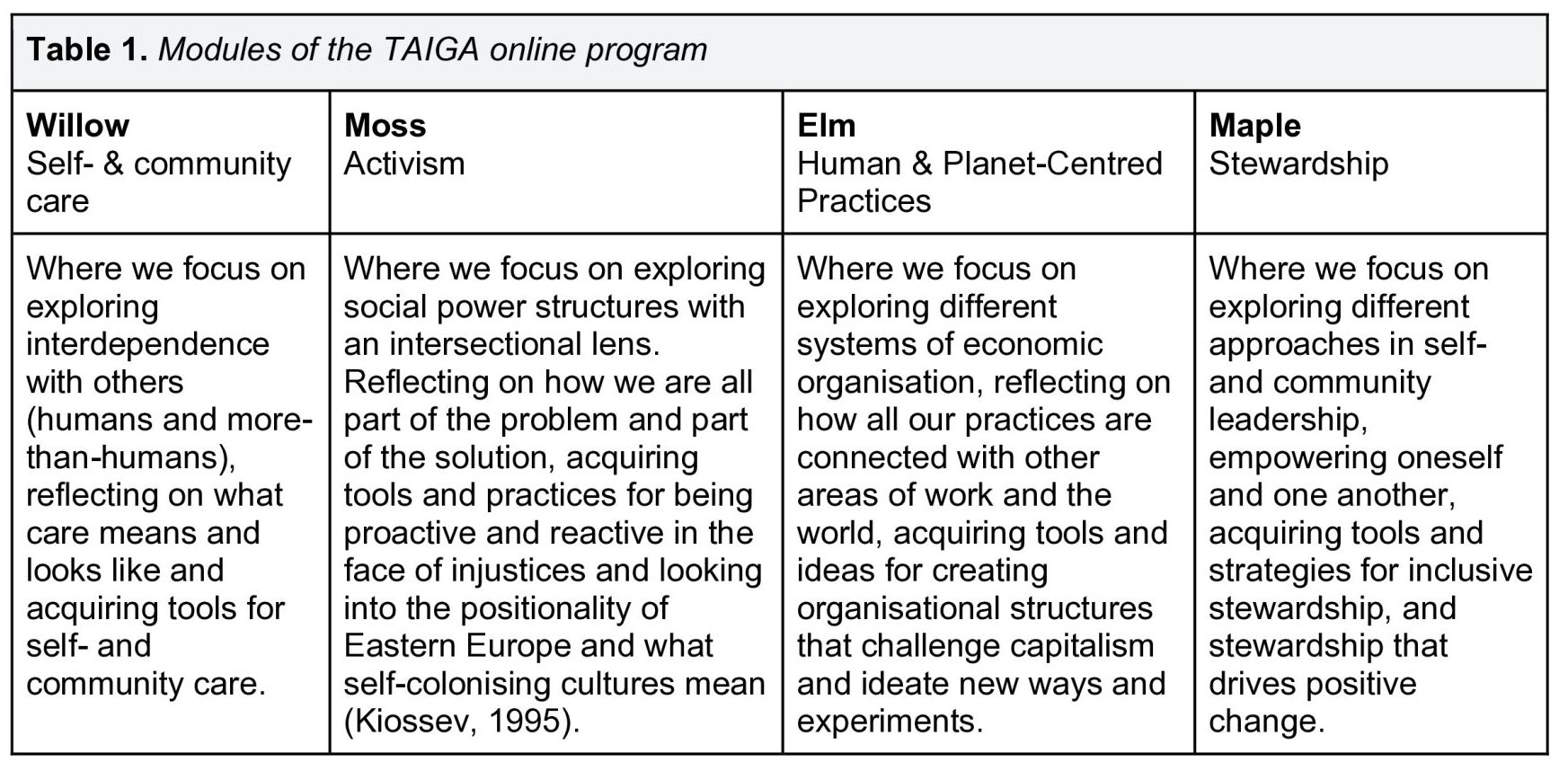
New visions was founded in 2020 by Liene Jurgelane and Agnieszka Bułacik. Starting as a project of two, it has grown into a community of 150+ folks working at the intersection of art and activism. Currently, the core team consists of four members of the community. The co-founders and previous core team has passed the work to a new team in the last months. The first Becoming TAIGA gathering was organised in 2022. All people who join the gathering have first participated in one of the cycles of TAIGA — an online (un)learning program “rooted in the acknowledgement that culture and art have been central in nearly every social movement in history and have a huge impact on shaping social awareness and driving change” (new visions, 2024) — and in queer-feminist and decolonial perspectives. It aims to create a deep, wide and nourishing mycelium-network of artists and activists in the eastern european region, through which the Europatriarchal narratives and colonial paradigms can be shifted. It offers practices and approaches which want to contribute to caring, resilient and radical stewardship of our movements, to cross-movements, cross-regional and cross-institutional relationships, acknowledging and addressing the social and ecological challenges of our times (new visions, 2024). The first pilot cohort of the online program was run in 2021, in a format described in table 1. Becoming TAIGA has become a space to exchange practices and perspectives, deepen relationships with ourselves, each other, and the living world, to regenerate and co-create the feminist movement we need and long for: a movement that considers the different crises we are in, that fights by healing, that expands resistances and builds trust and resilience. It fuels us with a sense of responsibility and is an exercise in collective world-making — learning to become with the world. This is where social movements are regenerated and strengthened, and perhaps even transformed into more regenerative processes of narrative shifts in the region. Over the past years, all of us who are part of this community have been continuously moved by the transformative potential of this space. We are artists, curators, people working in culture in various positions, while simultaneously active in the environmental justice movement, on the Polish-Belarusian border, in the queer-feminist and reproductive justice movement; living or coming from Latvia, Lithuania, Estonia, Poland, the Czech Republic, Slovakia, Ukraine, Belarus, and Serbia.
The online TAIGA Program consists of four modules (Table 1).
Contextualising Eastern Europe is important because it represents a specific context with distinct feminist and decolonial histories and conditions, because this is the region we come from and know intimately, and because we have ourselves struggled with grappling with our identities and how to create global alliances across our differences. As we stated before, TAIGA, the forest, becomes for us a model of collectivity, of a balanced ecosystem. We do this to build a strong supportive network of people who are part of social movements in the region. Becoming TAIGA wants to build a community where we can experiment with and establish new norms of togetherness and new norms of intimacy, helping us move toward social and ecological justice built on relational, cognitive, and affective justice (Andreotti et al., 2018); to look into the spaces of reconnection so we can reconnect with our roots and our power (Macy, 2021). Becoming TAIGA became a collective practice of utopia in growing relationships that break the colonial and extractivist frame of the Anthropocene logic (Miller, 2019), not free from challenges and failures, which we want to understand as lessons. An embodied being together framed around approaches crucial to us, such as: hyper-self-reflexivity and reflection on power and privilege, a holistic approach to learning and interconnectedness with various forms of life, our responsibility as humans living on planet Earth, the use of artistic, contemplative and somatic practices.
The gathering is formed on a set of invitations and commitments. The starting point is to be present and inviting folks to attend the relationships in the “now”, and from there to go further — what Machado de Oliveira, calls “digging deeper and relating more broadly” (2021, p. 58) — paraphrasing Rilke’s poem, to widen the circle of kin. This may require us to “reactivate the capacities of feeling, relating and imagining that have been deactivated in modernity” (Machado de Oliveira, 2021, p. 79). To remain open to co-conspiration about “possibilities of existence that are real but unthinkable or unimaginable in modernity” (Machado de Oliveira, 2021, p. 79) — including conspiring with other beings as a potential pathway to breaking the logic of modernity and challenging dominant paradigms of human exceptionalism. Conspiracy in its etymology means “to breathe together,” from the Latin conspirare: com– (together) and spirare (to breathe). The practices present during the gathering, brought collectively, aim to recalibrate our systems to have the courage to breathe together, to acknowledge our interdependence, and to see and feel more.
3.2. Becoming TAIGA gathering in 2024
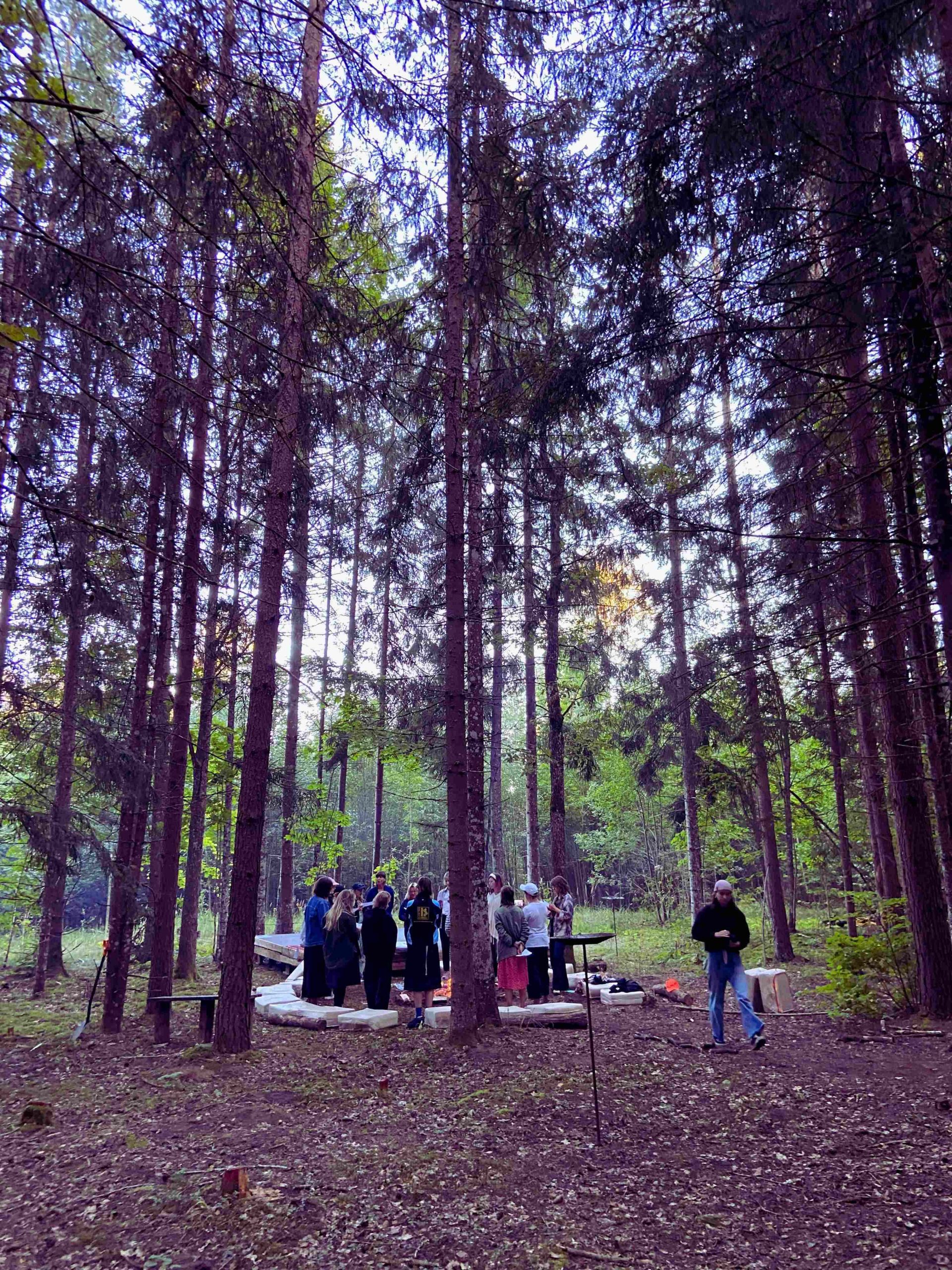
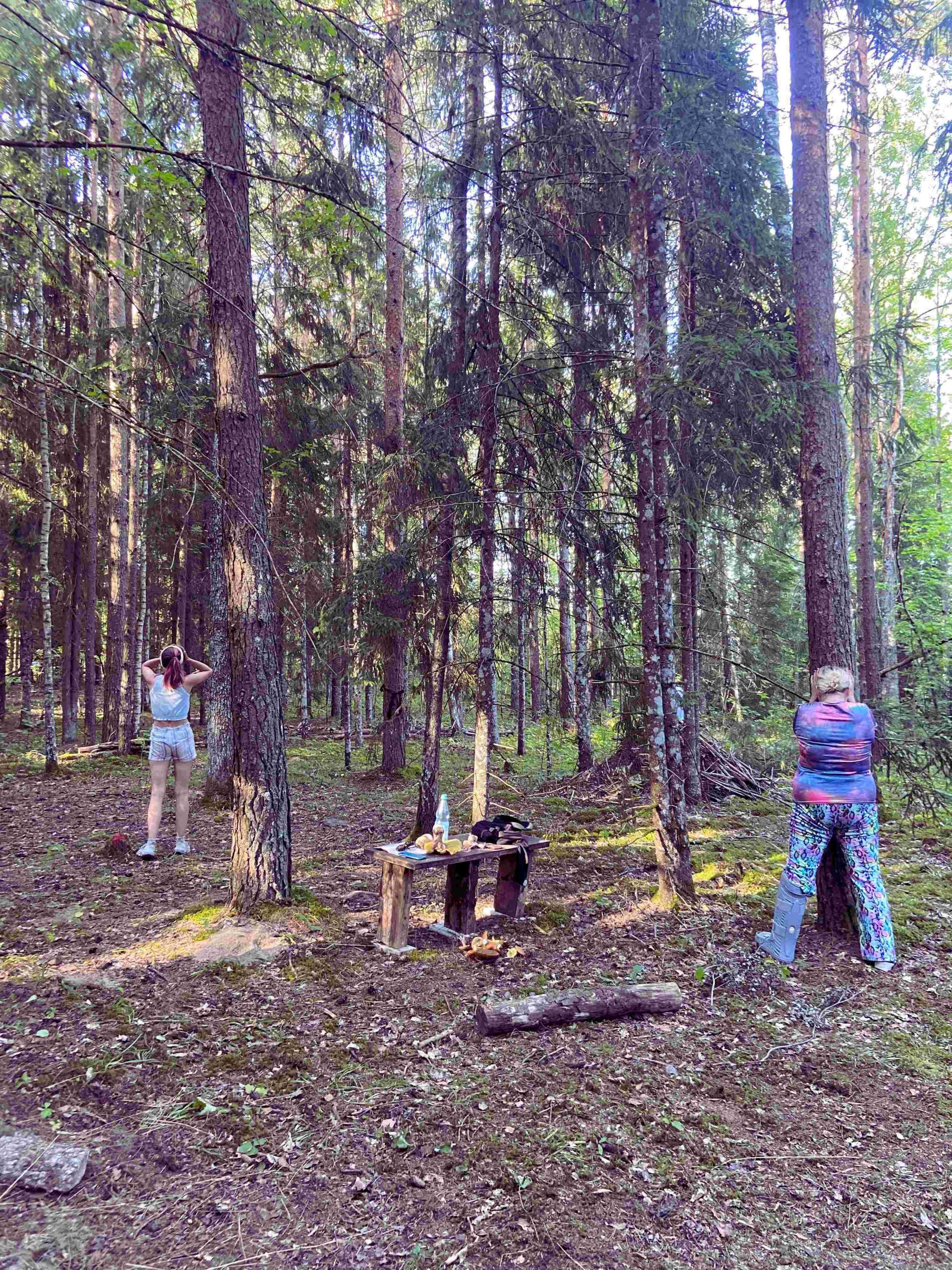
In 2024, we met in Suseja, Latvia, between the 13th and the 18th of August. We were 34 people in total: 27 participants, 5 team members, and 2 chefs. All participants identified as women, nonbinary, or genderqueer, and were between 20 and 50 years old. They were all engaged in their practice in art, activism, and social change. For those days, the forest became our home, and the community — both human and more-than-human — became part of it. People and place began to know one another: mingling, sensing, and connecting. Much of our time unfolded in non-verbal spaces of movement, dance, listening, touch, sound, and screaming. These embodied practices recalibrate the normative ways of being demanded by everyday life — ways that sustain our participation in, and complicity with, dominant systems. Becoming TAIGA is co-created fully with those participating in it, through shared responsibility for the shape of the program and collective facilitation. In 2024 all the logistics and administrative work was on the core team, yet the program contributions were brought by community members. The opening and closing rituals were held by the co-founders.
The Workshops
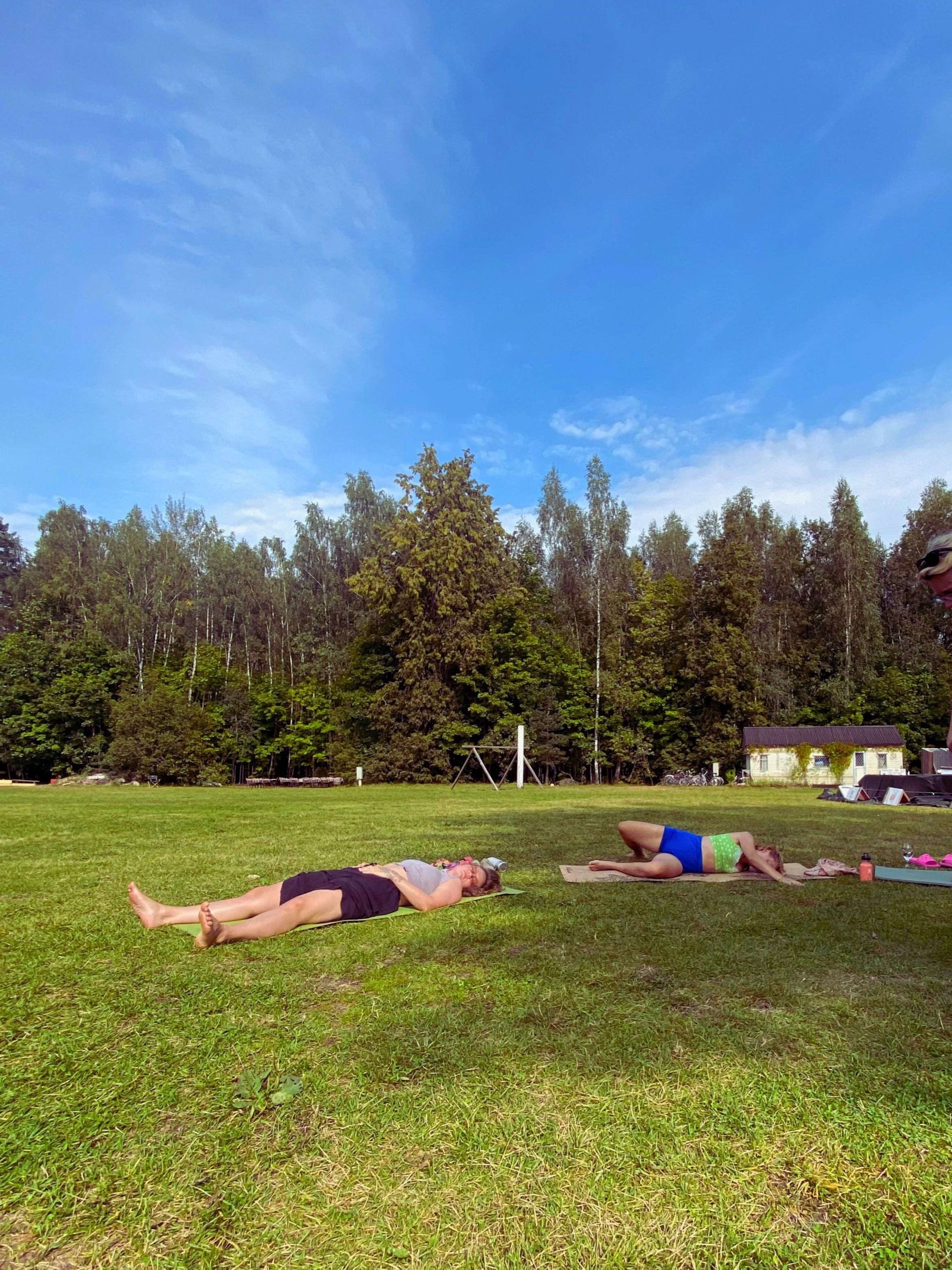
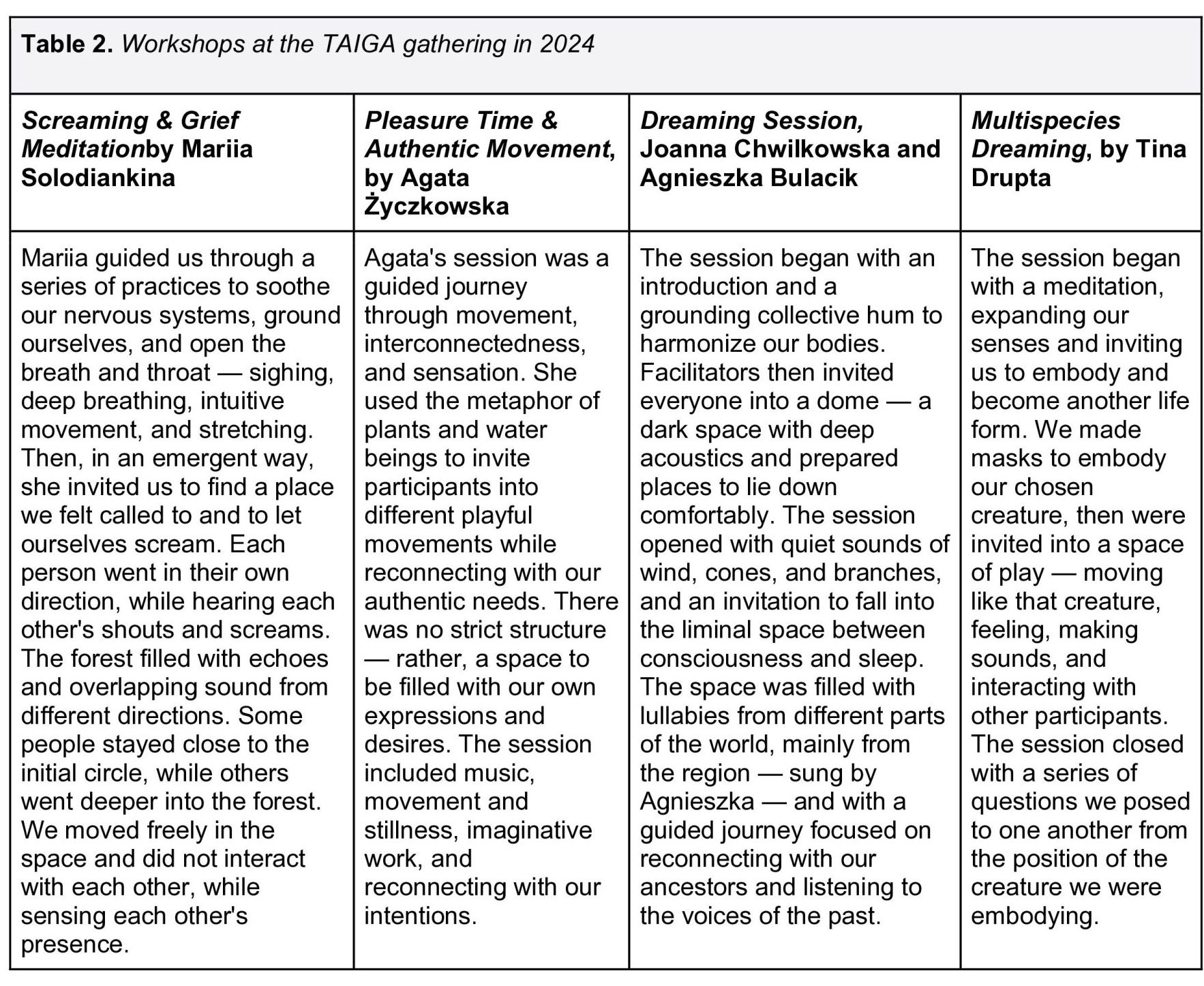
During the gathering, we focused on four sessions: Screaming and Grief Meditation by Mariia Solodiankina; Pleasure Time & Authentic Movement by Agata Życzkowska; Dreaming Session by Joanna Chwilkowska and Agnieszka Bułacik; and Multispecies Dreaming by Tina Drupte. Each session lasted between 45 minutes and 1.5 hours, and the number of participants varied from 7 to 17. They are described in more detail below. They were chosen by the research team, guided by curiosity, impact, and intuition (table 2).
3.3. Gathering stories and nurturing relationships (AKA “data collection”)
The main author of this article, Agnieszka Bułacik, invited three further members of the community to the research team: Liene Jurgelane, Tina Drupa, and Joanna Chwilkowska. Each person looked more closely at two sessions. We collected interviews-encounters with facilitators and with two participants from each workshop, and gathered our impressions as researchers, as well as photos, videos, and audio files from the gathering. We seek to expand the notion of data collection, understanding it as an ongoing practice of relating, exchange, and care. From feminist and decolonial perspectives, knowledge is not simply something that can be collected, but is produced through situated encounters and relationships (Haraway, 1988, Mignolo, 2007). This phase becomes a continuous commitment to attending to the exchanges of energy, time, emotions, knowledge, and care that make research possible, and transform it into the production, creation and deepening of relationships, not only knowledge.
The interviews with participants had two parts. The first one, focused on the sensorial and affective layer of the experience, conducted while laying down with eyes closed outside on the grass. The second one focused on the understanding of the experience itself and its possible impact. The set of questions can be found in Annex 1. The interviews were recorded and transcribed. Throughout the process, reflexivity was sustained through ongoing journaling and collective reflection. The ethnographies described their experiences and observations. The intention is to “decolonize our imaginary” (Rolnik, 2023; wa Thiong’o, 1986) and challenge the colonial norms that eliminated the capacity for sensing and being in the world — to bring back these capacities that have been exiled by late capitalism and colonialism.
On the last day of the gathering, the research group came together to harvest their experiences as researchers through a somatic, embodied practice. The practice involved one person, the sharer, sitting in the middle of the space, while two others gently guided their body through movement. As their body moved, the sharer articulated whatever emerged in connection with their research experience, without the need to organise it into a coherent or linear narrative. A fourth person acted as a note-taker, documenting what was shared. This mode of harvesting opened up a space for a poetic and fragmented language, allowing embodied and affective dimensions of the research experience to surface alongside more conventional forms of articulation. It also deepened relationships within the research team by creating a space of mutual attention and vulnerability.
4. The analytical lens
We look at the practice of braiding and connecting the personal and political, situating the analytical framework within decolonial, feminist and posthumanist epistemologies that challenge the hierarchical, dualistic, and anthropocentric logics of colonial modernity. While wanting to expose them, at times, there is a reproduction of the very modes of researching and relating we are aiming to challenge. Drawing particularly on the works of Vanessa Machado de Oliveira (2021), Minna Salami (2020), Donna Haraway (2008), and Maria Puig de la Bellacasa (2021), the analysis attends to practices of relationality, embodiment, and co-creation as modes of unlearning colonial modernity. These concepts guided the thematic organisation of the field materials — transcripts, observations, and creative documentation — allowing an exploration of how participants collectively experiment with enacting alternative ontologies of relation and care.
The analytical process, conducted by the first author, was focused on interview transcription and analysis, while willing to remain interpretive, iterative, and affectively attuned. This process aligns with feminist methodologies that value situated knowledges (Haraway, 1988), emphasizing the researcher’s entanglement within the field and the affective resonances that shape interpretation. It draws from the principles of embodied and sensory ethnography (Moscoso, 2020; Pink, 2009), in which presence, perception, and bodily awareness become instruments of inquiry. Reflexive journaling and somatic attunement served as critical tools for tracing how insights emerged through bodily sensations, emotional responses, and collective atmospheres.
The interpretive process was therefore not only analytical but also relational. In this sense, the analytical framework operates simultaneously as a conceptual and ethical orientation: analytically, it provides the vocabulary and theoretical grounding to understand how practices of inter-being, co-sensing, and radical tenderness destabilize colonial epistemologies; ethically, it enacts a mode of inquiry rooted in care, reciprocity, and attentiveness. While primarily focused on the nurturing aspects of the research process — such as space of self-reflection for those facilitating, deepening the relationships within the community, creating spaces of breath and integration for those who participate and might be overwhelmed with the number of invitations and proposals (stated in the feedback)— in further analysis it became clear that the research process and design itself was quite demanding and exhausting for the research team, who was also participating in a dense and intense gathering.
Puig de la Bellacasa (2017) writes about the risks of involving care in knowledge-making — describing it as a “labour of love” that can become a desire to silence what is uncomfortable or nasty. Yet, as she argues, knowledge making oriented by care, understood as the labours of love and attachment, is not incompatible with conflict (p. 78). This echoes bell hooks’s insight that love is connected to responsibility and justice — moving beyond idealisation while remaining committed to feminist multilayeredness. This raises a question about the layers of care and the reproduction of extractivist practices at different levels of research. The care ethics so central to this framework remain unclear, however, when it comes to caring for the forest itself. How does TAIGA perceive this work? How does it nourish her — or does it at all? Or does this care remain within the space of metaphor and inspiration, guiding the work without necessarily supporting a wider ecosystem at this moment?
5. The observations of phenomena and lived experiences
TAIGA’s collective endeavour of being with and in the world foregrounds the sensuous and somatic dimensions of presence, treating them as integral to the production of knowledge that cares (Puig de Bellacasa, 2017). It also considers how relationships built on curiosity and commitment can lead to interspecies entanglements (Haraway, 2008). Creative expression in the workshops became central to the research, and more importantly, the creation of relationships within the community. Practices such as movement, sound, multispecies dreaming, and poetic reflection were approached as epistemic events — forms of thinking and feeling through which alternative worlds could be sensed and articulated. These practices, embedded in the community’s everyday life, wanted to offer a space to explore interdependence, possibly imagine futures beyond colonial and patriarchal paradigms, and practice them in the present. The research surfaces five interrelated lines of inquiry, each explored below.
5.1. From personal pain to collective power, from the somatic to the political
Somatic and political dimensions of the participants’ togetherness surfaced on many levels. The foundational element is the creation of a container for collective practice — what might be called a safer and/or braver space (Arao & Clemens, 2013). It is important to note that everyone who joins the gathering has gone through the online TAIGA program, which already sets a common level of understanding. TAIGA program is framed by seven invitations, many of which are inspired by the Emergent Strategy work by adrianne maree brown (brown, 2017, p. 103), which intend to support folks to hold, witness, and transform personal and ancestral traumas, turning individual pain into a source of collective power and connection.
This was present in various spaces, such as the Screaming & Grief Meditation. “It’s such an ancestral practice”, says Mariia, the facilitator of the space. She follows:
“In each woman, there are generations of women who came before, and we are all kind of sisters, I feel. This ancestral practice allows us to connect to something that probably our great-grandmothers knew, especially in the context of Eastern Europe, where there is such a huge tradition of crying together — groaning, screaming, crying. All the songs are very sad, for many occasions: when somebody gets married, when somebody dies, women would cry together. So this grows this old tradition and holds the community together. It’s really bonding.”
This embodied experience transforms what can be an isolating experience of grief into a shared ritual capacity — one able to hold pain and, in doing so, generate collective strength. Such an outcome points to the role of somatic memory in processes of healing: it is through the body, rather than solely through cognition or narrative, that healing becomes possible. Staci Haines, in The Politics of Trauma (2019), writes about how individual somatic experiences relate to collective political transformation. It is by feeling into collective pain, bodily, that we can move towards justice. “Somatics understands both the individual and collective as a combination of biological, evolutionary, emotional, and psychological aspects, shaped by social and historical norms, and adaptive to a wide array of both resilient and oppressive forces” (p. 22). She speaks about systemic trauma as an experience of groups of people — affected by colonial violences, enslavements and also environmental destruction. Her work, contextualised and present in the United States, speaks a lot about enslavement and anti-blackness, and the impact of colonisation. Situating it in our geographical region, what comes to be visible is christianisation, and the german and russian occupations, which still live in the stories of our grandparents. The Catholic Church, too, continues to shape decisions about women’s bodies to this day: access to safe abortion, and the promotion of heteronormative values that put queer people in the region at risk. All of these layers remain present in our bodies and tissues.
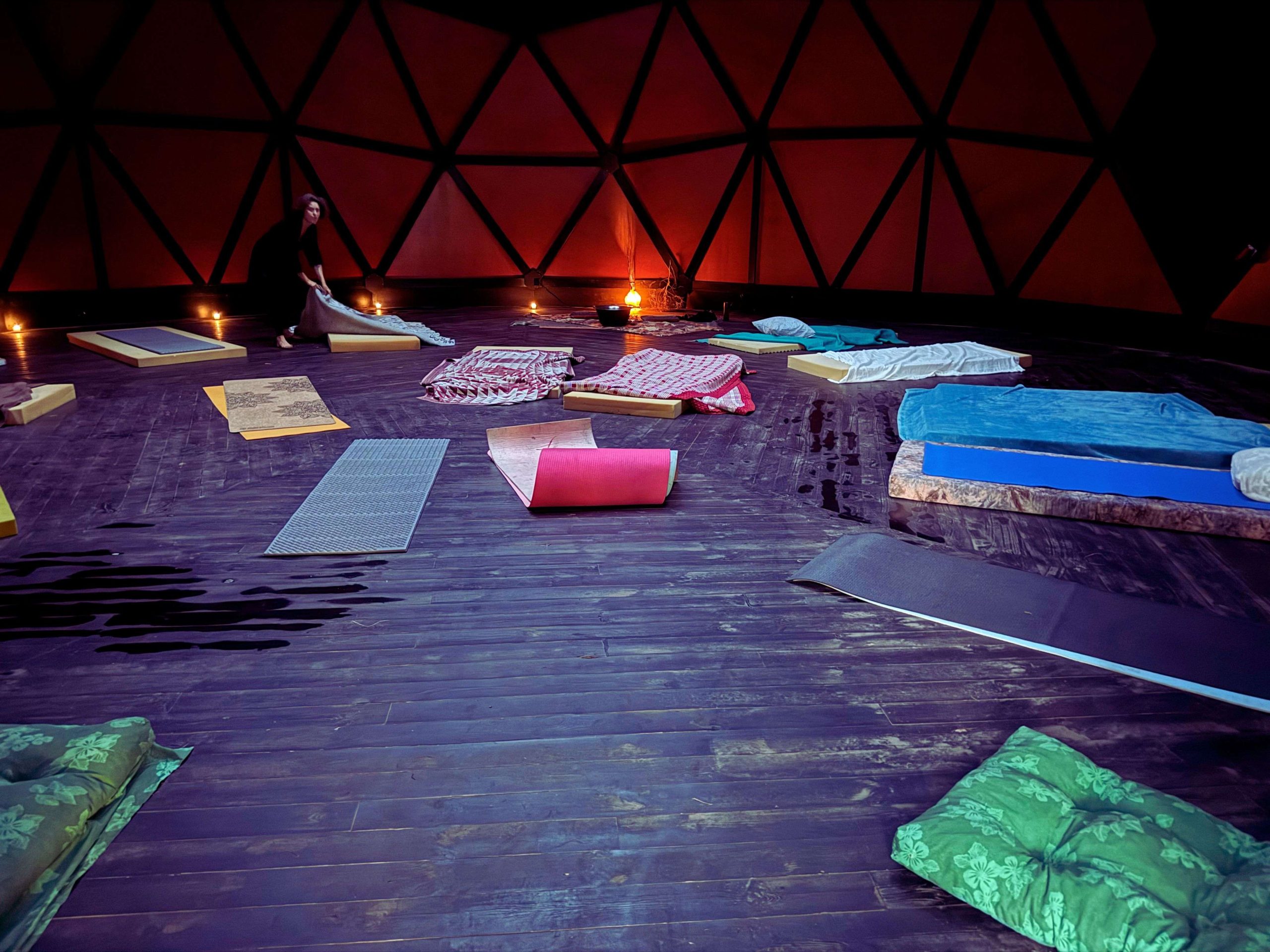
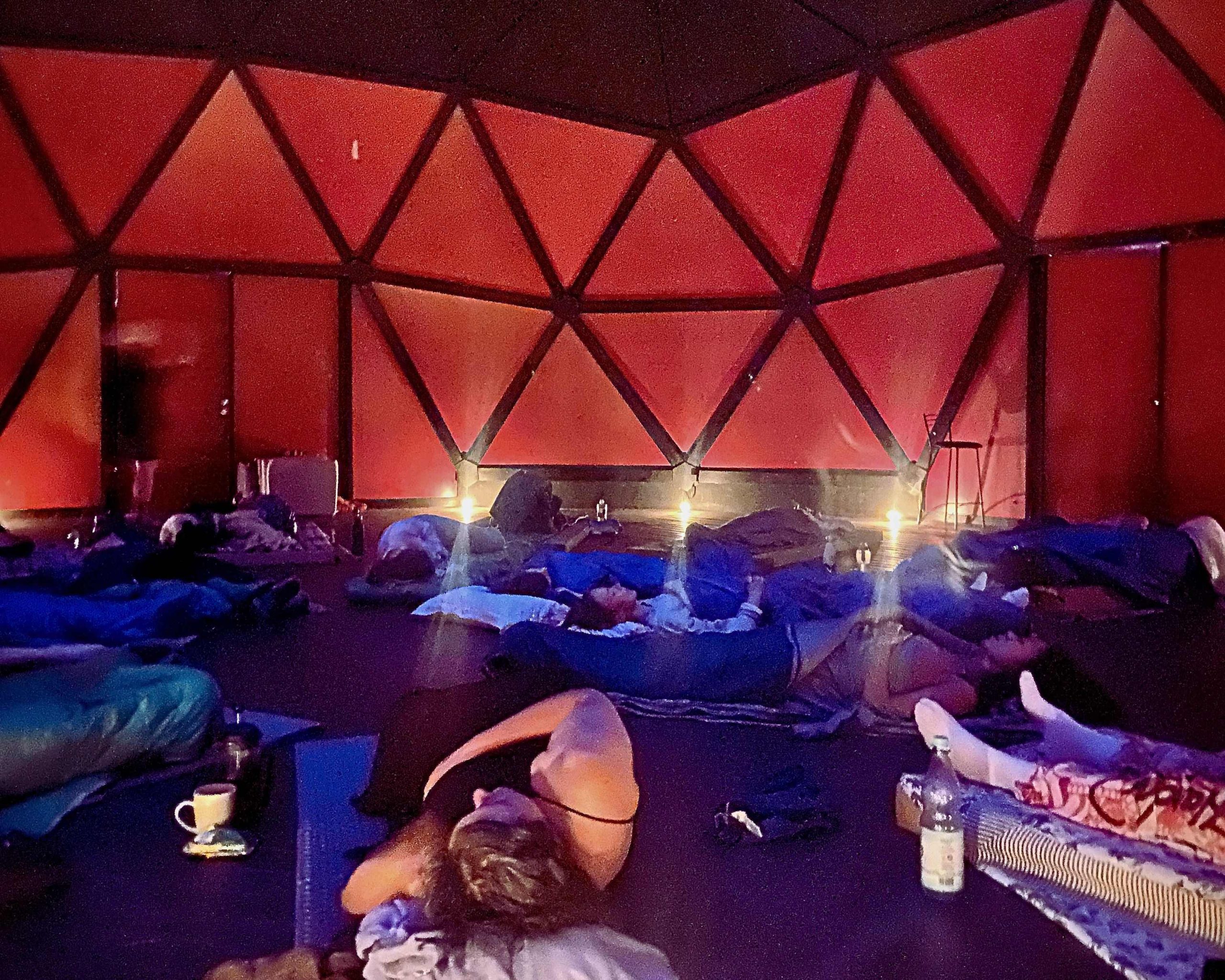
After the dreaming session, there were various instances of interconnectedness manifesting as contacts to shared generational stories of resilience and loss — connecting with our ancestors, our grandmothers, and the experiences that shaped them, and how these stories of loss unfold within one another, reverberating in the cells and hearts of those sitting in the circle. This radical acceptance destigmatizes the expression of grief and breaks through many taboos and fears (Brach, 2003). One of the participants speaks about the healing power of feeling “a heavy stone in their chest” as they sat next to a person, who was sharing a challenging personal story. They say:
“At the same time, I had never been in such a radically honest space, where we could say these things and stay with them. We were not trying to cover anything. Nobody was saying, “You have to be strong, you have to be this, you have to be that.” You didn’t have to be anything. You were just there, saying it, and everybody was fucking listening and feeling their own emotions through it.”
This widened capacity to be with the pain enables a deeper connection as it can also widen somatic capacity to “stay with the trouble” and learn how to be present with the wounded world (Haraway, 2016; Weber, 2021). The paths of change are non-linear and interactive, as brown (2017) argues, referring to grief as a time-travelling emotion. “It’s about communal healing,” says Mariia about the space she was holding — a space of both discomfort and release. Understanding and feeling into the layers of grief and shame coming from history of soviet domination, legacy of catholic church, patriarchal violences, current marginalisations.
5.2. The personal sphere and transcorporeality
Minna Salami, in her work Sensuous Knowledge: A Black Feminist Approach for Everyone (2020), writes dismantling as an act of “removing the mantle” — a process of unveiling the illusions that sustain oppressive systems. She argues that genuine transformation requires seeing reality clearly and holistically, engaging the full spectrum of human faculties: intellectual, emotional, spiritual, and sensory. Building on Audre Lorde’s thought, she writes: “the master’s tools are not: poetry, playfulness, Eros, borderlessness, conscientiousness, dialogue, intuition, soulfulness, stillness, warmth, passion, beauty, compassion, mystery, wisdom, honesty, femininity, interiority, sensuousness, ogbon-inu” (Salami, 2020, p. 145). For Salami, sensuous knowledge constitutes an epistemological framework that resists fragmentation, valuing intuition, embodiment, and aesthetic experience as legitimate sources of understanding. She contrasts these with the so-called “master’s tools” — the rationalist, extractive, and hierarchical logics that underpin Euro-patriarchal systems of thought.
In this context, sensuous knowledge becomes both a methodology and a praxis for reorienting perception toward relationality, wholeness, and the ethical interdependence of all beings. It is a poetic approach:
“A marriage of emotional intelligence with intellectual skill. It is perceiving knowledge as a living and breathing entity rather than as a packaged product to passively consume … Sensuous Knowledge is knowledge that infuses the mind and body with aliveness, leaving its impact behind like the wake of perfume. It is knowledge that is pliable and not as hard as rocks. Sensuous Knowledge means pursuing knowledge for elevation and progress rather than out of an appetite for power” (Salami, 2020, p. 15).
It is an invitation to feel, think and sense beyond one’s perceived physical boundaries, while exploring those.
A core tenet of the workshops is the deliberate shift away from the rational, individualistic mind and towards collective, embodied wisdom (Salami, 2020). They explicitly challenge the supremacy of what one participant called the “daily brain,” which is “very, very structured,” and instead cultivate access to subconscious, intuitive, and non-verbal states of knowing — the very sensuous knowledge. This decentering of the ego-self can be understood as a liberatory act that opens new possibilities for perception and relation, creating space for reclaiming other, often suppressed forms of knowledge and being. Participants speak of a profound “relief to leave myself a little bit.” This temporary dissolution of the self is framed as an antidote to the capitalist pressure to “strongly feel our identity,” offering a moment of freedom from the heavy work of performing a fixed, individual persona, a moment “to move beyond this very individualised western self.”
Through this, what becomes possible is reconnecting with the sensations, desires, and pleasures that constitute the authentic movement of a body otherwise forced to sit in a chair for long hours. Agata, the facilitator of the Pleasure Time & Authentic Movement workshop, says:
“I do think that the idea of a soft touch, a gentle way of being together, and pleasure is already a statement, a direction that is not colonial or oriented only toward productivity and extraction. In my work, these values of movement, touch, and focus on the body are very much present.”
It is what brown (2019) calls “pleasure activism”, claiming the body as a site of political resistance, inviting the sensations and states exiled from it through living in late capitalism. Participants share that this is how they can build trust in the body — feeling into what it needs, how it moves beyond the rigid structures of everyday movement patterns. It feels like recalibrating from states of productivity into feeling and being. Minna Salami (2025) speaks about the pyramid of power and the pyramid of knowledge, and how they are related: knowledge coming from the rational mind is treated as the most important, while knowledge coming from the body, intuition, and dreams are often dismissed in western science. She argues that to transform and deconstruct the pyramid of power — which grants the most authority to white western men — we must first deconstruct the pyramid of knowledge. What if there is no hierarchy of knowledge? What if all forms of knowledge are of value? How would we then construct our worlds?
5.3. Creative practices of healing and diverse knowledge making with/in the more-than-human world
The practices we looked at invite participants to adopt a non-anthropocentric perspective — to expand the meaning of “collective” to include more-than-human beings, and to actively work to dissolve the perceived separation between humans and nature. The goal of the practice at the Multispecies Dreaming workshop was to activate the imagination, to dream of different futures for all life, to shift our relationship with the living world from transactional to reciprocal, and to challenge anthropocentrism. It was perceived as both playful and profound experience. Tina, the facilitator, shares that she was:
“trying to pull it all together to open up a space where there might be a different way of opening up for people to experience space, time, and connection — a kind of pocket or portal to, maybe, see something a tiny bit different, possibly starting some deeper process that might allow curiosity to grow, or noticing a bit more what’s around.”
According to Tsing, who dedicates a chapter to the “art of noticing” in “The Mushroom at the End of the World: On the Possibility of Life in Capitalist Ruins” (2015),
“twentieth-century scholarship, advancing the modern human conceit, conspired against our ability to notice the divergent, layered, and conjoined projects that make up worlds. Entranced by the expansion of certain ways of life over others, scholars ignored questions of what else was going on. As progress tales lose traction, however, it becomes possible to look differently” (p. 22).
These practices sneak into these cracks. Tina, the facilitator, continues: “I think through connecting more closely to other beings, we might also open some possibility for imagining different futures — not only for ourselves but including the life that supports us and holds us here on this planet.” When turning towards the more-than-human, commons stand out as a natural state of the arts. Complex ecosystems demand living together with beings that are significantly different from one another, and it can help us imagine these kinds of relationships. The embodiment can support connection with sensuous knowledge (Salami, 2020), grounding in the here and now (Macy, 2021), and an erotic connection with life and the forest (Lorde, 1978). The process is intended to evoke empathy and a different relationality — bringing us closer to the ecological understanding that the ecological is social, and that the social is ecological (Bookchin, 1993) — and moves further towards deep ecology (Macy, 2021). It also offers a space for freeing oneself from the social dimension of identity, which can at times feel like entrapment. “It felt like a relief — free, somehow” says Agnieszka, a workshop participant:
“It reminded me of old traditions in Polish villages, when they would do kolęda (literal translation is ‘corralling’) and also change how they look — putting on masks, and becoming angels, devils, or bears. It just felt so good to kind of lose yourself for some time, not having the pressure to talk through who you are, but to talk through someone else, a non-human creature — to imagine how it is to be that creature and to see the world through different eyes.”
These practices are rooted in ethics that actively dismantle the hierarchies between the human and non-human, beginning with the decentering of the individualized, rational self. At times, such practice operates without predetermined outcomes, guided by intuition and felt experience, experimenting with varying levels of intimacy and closeness between humans and more-than-human beings.
5.4. Performance and group politics within the TAIGA participants
TAIGA work is rooted in the acknowledgement that performative and artistic work is an important method in intersectional feminist practice, enabling us to both register the past and envision futures of liberation (Gurudev, 2021). The gathering works with practices of authentic movement and dance, poetry, connecting with plants and herbs, and rituals that help us be with the land. Collective work and the exchange of practices, strategies, and experiences lie at the heart of deepening our bonds and awareness. These various practices of recalibration serve as guides to activate the capacities that have been numbed within the current system.
Yet also, while working with reconnection, it is based on exclusion. The participants of the gathering are all women and queer folks, there are no cis-men in the space. The intention to create a safe(r) space, and a space in which certain conversations can flow freely without an extra work of explaining — oftentimes invisible to cis-men structures of patriarchy — is on the cost of exclusion. Folks are coming from Eastern Europe and/or based there. Primarily, the call was inviting people from Latvia, Lithuania, Ukraine and Poland, due to fundraising strategy, yet in the past two years, thanks to flexible funding, Eastern Europe is understood more broadly, including Baltics and Balkans. While the team would want folks from the Caucasus to participate, the time difference between territories makes it difficult. The program is run in English, which requires good knowledge of the language to participate, excluding those who do not have it. Puig de Bellacasa (2017) reminds us that “relationality is all there is, but this does not mean a world without conflict or dissension” (p.78). The impossibility to be connected with and to care for everything, forces one to make decisions about what kind of space one chooses to create, with an invitation to think how those decisions and exclusions can foster relationships. These collectives, creating certain cuts, may also be read as spaces to recalibrate our forms of relating, not to divide or separate, but to find ways to relate differently outside the collective. As a queerfeminist space, it yearns to reduce the impact and harms of patriarchy during the time of gathering, yet it cannot possibly eliminate it; since as bell hooks (2019) reminds us, “patriarchy has no gender” (p. 142). Patriarchal patterns can surface within the group itself, regardless of gender identity — a reminder that dismantling patriarchy is not simply a matter of who is present, but of the structures and habits we carry with us, even into spaces explicitly built to resist them.
5.5. The production of counter-narratives
Eastern Europe is a region affected by armed conflict in Ukraine and continuous provocations by russia. It holds the eastern Schengen border, which currently is the safest, while still deadly, route to reach Europe for people on the move. The high militarisation of the border includes the construction of a wall, passing the laws which decriminalize and grant immunity for the use of firearms, and the practice of pushback of people trying to cross the border, among many other violent practices which seek to be legalised. In the last years, the region has been facing attacks on women’s rights, such as banning in effect the access to legal abortion in Poland — being only allowed in cases of rape, incest and serious danger to the life of the pregnant person, and even in these circumstances, accessing abortion remains almost impossible due to stringent legal and institutional barriers — or discussions about possible withdrawal from the Istanbul Convention in Latvia. Co-creation of counter-narratives to the norms of domination and violence becomes possible through the space of experimentation — exploring what it means to be together, with whom, acknowledging absences, and attending to felt presences. It does not offer solutions, yet proposes something different to what we have.
At times, it might be read as a desire to escape the violent reality. One of the workshop facilitators, Tina, spoke about the creation of “pockets of even more extended time” to explore different lifeways — the weird, the trippy, the beyond-normal. At times, this caused resistance in some persons, reluctance to join. Reactions like this reflect the departure from conventional social and pedagogical norms, into what is unknown. Yet, it can also become a space for expansion of the self, a space of freeing oneself from the limits of the everyday to gather energy, inspiration, hope, and trust — a space for reorientation (Ahmad, 2006). It might be a space of shapeshifting, as bodies are transformed by the proximity of different bodies, objects, and stories. What do we do with the space and also what this space allows us to do or does with us? How does it allow us to think, to be, to practice, to experiment? How the bodies, affected by histories and herstories, move, and get into dialogue?
Participants speak of “this dance between our softness and our stiffness,” while facilitators address the need for an emergent process, responding to the needs arising in the space. It is developed in a sphere of relationality and trust. “Social change happens at the speed of relationships. And relationships move at the speed of trust” said Jen Bailey (‘Let Us Move at the Speed of Trust’, 2022), the founder of Faith Matters Network. We read it as a call for courageous spaces to build solid and nourishing mycelium, in which we can dream radical social changes into being. This pedagogy of experimentation centres vulnerability and determination and exposes learning as transgressive practice (hooks, 1994). What wants to happen here is a constant conversation, what Freire (1970) would call liberatory education. One that is not free from challenges, misunderstandings and tensions, which are inseparable elements of (un)learning process.
6. Discussion and conclusion
6.1. Becoming TAIGA as a space to cultivate forms of relationality that counter hyperindividualism and human exceptionalism
In a hyperindividualized world, learning interdependence and cultivating the capacity for feeling-with may constitute a long and difficult path. When we first gathered at Becoming TAIGA in Massiaru, Estonia, back in 2021, we knew we were bringing together people who did not want to only dream about a different world, but to build and practice it in their everyday. We did not know yet how it would unfold — and if it even would at all. TAIGA grew out of the desire to build a long intentional mycelial network of relationships in the region, where we can witness, and can accompany one another on our healing and justice paths. Each person brings their very practices to exchange, and checks how things can work out for one another, with a full awareness that we are very different people, and also differently shaped by the systems we live in. While working with the stories and weavings gathered at Suseja in 2024, what stands out is the reviving of the capacity to be present with the body and the feelings through which folks can reconnect with themselves and one another. It happens in non-verbal spaces, it happens in the way folks connect with plants and life, and also with their ancestors. It also happened through distancing oneself from the “human self” — the seriousness — and activating certain curiosity.
The interconnected themes of collective embodiment, decolonial practice, and radical experimentation offer a powerful and holistic model for healing the wounds of separation endemic to modern, colonial cultures. By creating safe containers for shared vulnerability, these experiences transform individual pain into collective strength. By decentering the individual ego and re-centering the wisdom of the body, ancestors, and the more-than-human world, they reclaim suppressed ways of knowing, being, and open a space in which the unknown becomes a source of profound regeneration and connection. These practices are creative and political acts that actively grow new worlds by fostering more just and more intimate ways of relating to oneself, to each other, and to the entire web of life.
6.2. Personal and collective transformation through collective, embodied, and multisensory practices
To practice new world(s), what is first needed is to unlearn the patriarchal, extractivist, capitalistic and colonial ways of being. To reactivate the sensuous, and tender, and soft, and to work against the numbing that the current system puts us in — as Agata and Tina share about it in their interviews. It is the space of tenderness, the radical tenderness, as the work of Dani D’Emilia and Pocha Nostra (2018) calls it. John Berger speaks about the work of tenderness as “a passion of the body to share with another body” (sdeslimbes, 2013). He argues that tenderness is a response to pain, but it is also a refusal to judge, and this is how it becomes the portal to freedom. These practices might be framed as decolonial and anti-capitalist resistance: spaces where one can unlearn oppressive conditioning, scream against patriarchal silencing, experiment with moving beyond human imagination.
Members of the TAIGA community are engaged in diverse yet interconnected struggles: environmental justice movements, queer and feminist activism in the region, solidarity with people on the move across the Eastern Schengen border, reproductive rights advocacy, and racial justice work. Together, we seek to understand what is being asked of us in this historical moment — what forms of responsibility and response-ability (Haraway, 2016) are required, and how to avoid reproducing the very systems of domination and exploitation we are attempting to dismantle. This includes critically reflecting on how activist and artistic practices can unintentionally mirror neoliberal patterns of overwork, self-exploitation, self-centering, arrogance and burnout.
This work posits that, as the world undergoes unprecedented transformation, nurturing imagination, care, and hope emerges as an ethical and political imperative — as a radical practice of survival and solidarity, centring cultivating faith in one another, building collective resilience, and sharing embodied and creative tools for endurance and regeneration. Hope is thus positioned as a deliberate political stance: an act of refusal against despair, cynicism, and the paralysing logics of individualism and greed.
This inquiry invites further consideration of how decolonial practices might be contextualized more deeply within the specific historical and geopolitical realities of Central and Eastern Europe — a region shaped by both Western and russian imperial formations. As Kasia Narkowicz observes,
“Whiteness and Europeanness so starkly mark Central Eastern European identity because, at different times throughout our history, the promise of being fully embraced as Europeans, with all that it grants, has been dangling in front of us as a carrot” (Narkowicz, 2021).
Her analysis illuminates how this ambivalent positioning has led, in some contexts, to complicity with “Fortress Europe” narratives and the reproduction of racialized border politics. Within this complex terrain, the question emerges: how might such histories be integrated into personal and collective processes in ways that bring about meaningful transformation? How might new modes of being-together be co-created to move beyond the normative life- and world-making logics of colonial modernity, without collapsing into urgency, panic, or paralysis?
Rather than seeking resolution or closure, this approach frames the work as a practice of sustained inquiry — a willingness to remain with discomfort, contradiction, and uncertainty. This orientation requires resisting the seduction of solutionism and the performative acceleration demanded by late capitalism. Bayo Akomolafe (n.d.) reminds us, “The times are urgent; let us slow down”. It is precisely through such slowness — through practices of attentiveness, relationality, and care — that reimagining the conditions of possibility for collective life beyond the exhausted frameworks of modernity becomes feasible.
References
Ahenakew, C. (2016). Grafting Indigenous ways of knowing onto non-Indigenous ways of being. International Review of Qualitative Research, 9(3), 323–340. https://doi.org/10.1525/irqr.2016.9.3.323
Ahmed, S. (2006). Orientations: Toward a Queer Phenomenology. Glq-a Journal of Lesbian and Gay Studies, 12, 543-574. https://doi.org/10.1215/10642684-2006-002
Akomolafe, B. (2017). Entangled with the world. Retrieved May 30, 2024, from https://www.bayoakomolafe.net/post/entangled-with-the-world
Akomolafe, B. (n.d.). Times are urgent, let us slow down. Retrieved September 9, 2024, from https://www.bayoakomolafe.net/post/the-times-are-urgent-lets-slow-down
Akomolafe, B., & Manish, J. (2016). Practitioner perspective: This revolution will not be schooled: How we are collectively improvising a “new story” about learning. In Education, learning and the transformation of development (pp. 106–122). Routledge.
Andreotti, V., & d’Emilia, D. (n.d.). Co-sensing with radical tenderness. Retrieved July 25, 2026, from https://decolonialfutures.net/rt-recording/
Andreotti, V., Stein, S., & Susa, R. (2018). From the house that modernity built to healthy mycelium. Gesturing Towards Decolonial Futures. Retrieved July 25, 2026, from https://decolonialfutures.net/portfolio/mini-zine-house-mycelium/
Arao, B., & Clemens, K. (2013). From safe spaces to brave spaces: A new way to frame dialogue around diversity and social justice. In L. M. Landreman (Ed.), The art of effective facilitation: Reflections from social justice educators (pp. 135–150). Routledge.
Barad, K. (2007). Meeting the universe halfway: Quantum physics and the entanglement of matter and meaning. Duke University Press.
Bookchin, M. (1993). What is social ecology? In M. E. Zimmerman (Ed.), Environmental philosophy: From animal rights to radical ecology (pp. 354–373). Prentice Hall.
brown, a. m. (2017). Emergent strategy: Shaping change, changing worlds. AK Press.
brown, a. m. (2019). Pleasure activism: The politics of feeling good. AK Press.
d’Emilia, D. (2018, October 26). Ternura radical / radical tenderness. Dani d’Emilia. Retrieved July 25, 2026, from https://danidemilia.com/2018/10/26/ternura-radical-radical-tenderness-post/
Escobar, A. (2018). Designs for the pluriverse: Radical interdependence, autonomy, and the making of worlds. Duke University Press.
Facing Human Wrongs. Retrieved April 9, 2026, https://facinghumanwrongs.net/
Fals Borda, O. (2015). Una sociología sentipensante para América Latina. Siglo XXI Editores.
Fujino, D. C., Gomez, J. D., Lezra, E., Lipsitz, G., Mitchell, J., & Fonseca, J. (2018). A transformative pedagogy for a decolonial world. Review of Education, Pedagogy, and Cultural Studies, 40(2), 69–95. https://doi.org/10.1080/10714413.2018.1442080
Freire, P. (1970). Pedagogy of the oppressed. Herder and Herder.
Gan, E., Tsing, A., Swanson, H., & Bubandt, N. (2017). Introduction: Haunted landscapes of the Anthropocene. In A. Tsing, H. Swanson, E. Gan, & N. Bubandt (Eds.), Arts of living on a damaged planet: Ghosts of the Anthropocene (pp. 1–14). University of Minnesota Press.
Gurudev, S. (2021). Performance as methodology: Embodied archives and fabulation. Feminist Anthropology, 2(2), 312–324. https://doi.org/10.1002/fea2.12061
Haines, S. K. (2019). The politics of trauma: Somatics, healing, and social justice. North Atlantic Books.
Haraway, D. (1988). Situated knowledges: The science question in feminism and the privilege of partial perspective. Feminist Studies, 14(3), 575–599. https://doi.org/10.2307/3178066
Haraway, D. (2008). When species meet (Vol. 3). University of Minnesota Press.
Haraway, D. (2016). Staying with the trouble. Duke University Press.
hooks, b. (1994). Love as the practice of freedom. In Outlaw culture: Resisting representations (pp. 289–298). Routledge.
hooks, b. (2010). Teaching critical thinking: Practical wisdom. Routledge.
Jhally, S., Patierno, M., & Hirshorn, H. (1997). bell hooks—Cultural criticism & transformation [Film]. Media Education Foundation.
Jones, P. (2011). Transformative learning, ecopedagogy and learning ecology: Pathways for social work education. In Eco-social justice: Issues, challenges and ways forward (pp. 1–24). Books for Change.
Kimmerer, R. W. (2015). Braiding sweetgrass. Milkweed Editions.
Kiossev, A. (1995). Notes on self-colonising cultures. In D. Ginev, F. Sejersted, & K. Simeonova (Eds.), Cultural aspects of the modernisation process (pp. 73–82). TMV-senteret.
Let Us Move at the Speed of Trust. (2022, October 26). Einhorn Collaborative. Retrieved July 5, 2026, from https://einhorncollaborative.org/let-us-move-at-the-speed-of-trust/
Lorde, A. (1978). Uses of the erotic: The erotic as power. Out & Out Books.
Lorde, A. (2007). The master’s tools will never dismantle the master’s house. In Sister outsider: Essays and speeches (pp. 110–114). Crossing Press.
Machado de Oliveira, V. (2021). Hospicing modernity: Facing humanity’s wrongs and the implications for social activism. North Atlantic Books.
Macy, J. (2021). World as lover, world as self: 30th anniversary edition: Courage for global justice and planetary renewal. Parallax Press.
Macy, J., & Brown, M. (2014). Coming back to life: The updated guide to the work that reconnects. New Society Publishers.
Madjidi, K., & Restoule, J. (2008). Comparative indigenous ways of knowing and learning. In K. Mundy, K. Bickmore, R. Hayhoe, M. Madden, & K. Madjidi (Eds.), Comparative and international education: Issues for teachers (pp. 77–106). Teachers College Press.
Majewska, E. (2021). Feminist antifascism: Counterpublics of the common. Verso Books.
Mezirow, J. (1978). Perspective transformation. Adult Education, 28(2), 100–110. https://doi.org/10.1177/074171367802800202
Mezirow, J. (2009). An overview on transformative learning. In K. Illeris (Ed.), Contemporary theories of learning: Learning theorists—in their own words (pp. 90–105). Routledge.
Mignolo, W. (2023). The explosion of globalism and the advent of the third nomos of the earth. In M. Steger, R. Benedikter, H. Pechlaner, & I. Kofler (Eds.), Globalization: Past, present, future (pp. 193-207). University of California Press. https://doi.org/10.1525/luminos.172.m
Mignolo, W. D. (2007). Delinking: The rhetoric of modernity, the logic of coloniality and the grammar of de-coloniality. Cultural Studies, 21(2–3), 449–514. https://doi.org/10.1080/09502380601162647
Miller, T. L. (2019). Plant kin: A multispecies ethnography in indigenous Brazil. University of Texas Press.
Moscoso, M. (2020). Sobre etnografías experimentales y sensoriales. BAU Ediciones.
Mullen, C. A. (2020). Pedagogies for decolonizing education in theory and practice. In C. A. Mullen (Ed.), Handbook of social justice interventions in education (pp. 1–27). Springer. https://doi.org/10.1007/978-3-030-29553-0_91-1
Myers, N. (2017). From the anthropocene to the planthroposcene: Designing gardens for plant/people involution. History and Anthropology, 28(3), 297–301. https://doi.org/10.1080/02757206.2017.1289934
Myers, N. (2018). Becoming sensor in sentient worlds: A more-than-natural history of a black oak savannah. In G. Bakke & M. Peterson (Eds.), Between matter and method: Encounters in anthropology and art (pp. 73-98). Bloomsbury Academic.
Myers, N. (2020, October 14). On growing the Planthropocene/204 [Audio podcast episode]. For the Wild. https://forthewild.world/listen/dr-natasha-myers-on-growing-the-planthroposcene-204
Narkowicz, K. (2021). On peripheral whiteness and being central Eastern European. Retrieved September 5, 2024, from https://thefunambulist.net/magazine/fifty-shades-of-whiteness/on-peripheral-whiteness-and-being-central-eastern-european
New Visions. TAIGA. Retrieved July 9, 2026, from https://newvisions.me/taiga
Quay, J. (2021). Wild and willful pedagogies: Education policy and practice to embrace the spirits of a more-than-human world. Policy Futures in Education 19(3), 291–306. https://doi.org/10.1177/1478210320956875
Quijano, A. (2000). Coloniality of power, Eurocentrism, and Latin America. Nepantla: Views from South, 1(3), 533–580. https://doi.org/10.1177/0268580900015002005
Pink, S. (2009). Doing sensory ethnography. Sage.
Puig de la Bellacasa, M. (2017). Matters of care: Speculative ethics in more than human worlds. University of Minnesota Press.
Rolnik, S. (2023). Spheres of insurrection: Notes on decolonising the unconscious. Polity Press.
Salami, M. (2020). Sensuous knowledge: A black feminist approach for everyone. Zed Books.
Salami, M. (2025, August 19–21). How can we reimagine knowledge in a time of ecological and epistemic crisis? [Keynote address]. EARTHBOUND 2025 Symposium: Soil & Water, Ry and Aarhus, Denmark.
sdeslimbes. (2013, April 7). John Berger on tenderness, the dead, freedom, bikes (with Michael Silverblatt) [Video]. YouTube. https://www.youtube.com/watch?v=yVBgzqMGYtA
Simard, S. (2021). Finding the mother tree: Uncovering the wisdom and intelligence of the forest. Allen Lane.
Spivak, G. C. (1985). The Rani of Sirmur: An essay in reading the archives. History and Theory, 24(3), 247–272. https://doi.org/10.2307/2505169
Ştefănescu, B. (2012). Reluctant siblings: Methodological musings on the complicated relationship between postcolonialism and postcommunism. Word and Text: A Journal of Literary Studies and Linguistics, 2(1), 13–26. https://jlsl.upg-ploiesti.ro/documente/Arhiva_nou/2012_1/01Stefanescu.pdf
Stein, S., Andreotti, V., Ahenakew, C., Suša, R., Valley, W., Huni Kui, N., Tremembé, M., Taylor, L., Siwek, D., Cardoso, C., Duque, C. ‘Azul’, Oliveira Da Silva Huni Kui, S., Calhoun, B., Van Sluys, S., Amsler, S., D’Emilia, D., Pigeau, D., Andreotti, B., Bowness, E., & McIntyre, A. (2023). Beyond colonial futurities in climate education. Teaching in Higher Education, 28(5), 987–1004. https://doi.org/10.1080/13562517.2023.2193667
Stein, S., Andreotti, V., Suša, R., Amsler, S., Hunt, D., Ahenakew, C., Jimmy, E., Cajkova, T., Valley, W., Cardoso, C., Siwek, D., Pitaguary, B., D’Emilia, D., Pataxó, U., Calhoun, B., & Okano, H. (2020). Gesturing towards decolonial futures: Reflections on our learnings thus far. Nordic Journal of Comparative and International Education (NJCIE), 4(1), 43–65. https://doi.org/10.7577/njcie.3518
Susa, R. (2021). Imagining transformation otherwise: Case studies of learning practices. Bridge 47.
Thiong’o, N. wa. (1987). Decolonising the mind: The politics of language in African literature. Zimbabwe Publishing House.
Tlostanova, M. (2025). Double critique revisited, or does it matter who is the most legitimate victim? The Thinker, 104(3), 93–101. https://doi.org/10.36615/057wjv55
Tooze, A. (2021). Shutdown: How Covid shook the world’s economy. Columbia University Press.
Tsing, A. L. (2015). The mushroom at the end of the world: On the possibility of life in capitalist ruins. Princeton University Press.
Varga, M. (2022). Mental Maps of Eastern Europe: States, Mentalities, Modernisation. Journal of Historical Sociology, 35(4), 372–388. https://doi.org/10.1111/johs.12390
Wang, V. X. (Ed.). (2018). Critical theory and transformative learning. IGI Global. https://doi.org/10.4018/978-1-5225-6086-9
Weber, A. (2021). Matter & desire: An erotic ecology. Chelsea Green Publishing.
Weber, R. (2021). Somatics: Practices toward developing environmental empathy. Avant, 12, 1–21. https://doi.org/10.26913/avant.2021.02.06
Annex
Interview with facilitators
● What is this about for you?
● Why do you do this work?
● Why do you want to share it in this context?
● For you, how does this work relate to collectivity, collective body, reconnection?
● What is this work’s relation to decoloniality? How does this work relate with decoloniality?
● How open are you for experiments and improvisations in this process? How do you work with the unknown, unpredictable, emergent in the process?
● Do you think that this work contributes to creating a livable world for all in a current sociopolitical context? How?
Observations – guidelines for field notes
The invitations are quite broad here, so we can sit together and choose how to do the observations process.
● Relationships — how people interact
● Bodies — the movements, rhythms,
● Land — how is it with the humans, how are humans with the land,
● Connection — connectivity, fugitivity
● Dynamics — emergence, moments of uncertainty
● Tensions — in the bodies, between the people, in the process
Interview afterwards (with participants and in the team)
Sensorial, emotional, relational — with 1 or 2 participants, inviting them to keep their eyes closed and connect with their sensorial self and their imagination (should we reformulate the questions to keep them more open for imaginations? Feel free to let it be flowy and organic.)
● How did you feel throughout this process?
● What have you heard, senses, smelled, felt, seen?
● What is opening up in you after this experience?
● What kind of resistances have you sensed, noticed in yourself?
● How have you felt and do you feel in relation to yourself? To others?
● How can you bring this work into your life? How can it be helpful in navigating your day-to-day life, struggles, fights? What do you feel would be helpful to bring and practice in your everyday life?
● What learnings do you want to take with yourself and experiment with after this gathering?